
Confused about the new student loan rules? You’re not alone. The One Big Beautiful Bill Act was signed into law on July 4, 2025, and it brings some of the most sweeping student loan changes of 2025.
From repayment plans to forgiveness options and future borrowing limits, the landscape is shifting fast. This article breaks it all down in plain English: what’s changing, when it’s happening, and what it means for you.
SAVE Plan September 2025 Update: Interest Restart
As of August 1, 2025, interest officially resumed for nearly 8 million borrowers in the SAVE plan, even though monthly payments are still paused through January 31, 2026.
This is happening because the courts blocked key parts of SAVE, and the Department of Education says it no longer has the legal authority to keep rates at 0% during the forbearance period.
What this means for borrowers
- Interest is now building up on SAVE loans, and some borrowers have reported calculation errors on their accounts.
- Servicers are still showing confusing or premature payment due dates, even though payments remain paused.
- Forgiveness credits are frozen under SAVE, PAYE, and ICR due to ongoing lawsuits.
What can you do?
- Check your servicer account regularly to make sure balances and due dates are correct. Keep screenshots or records in case of disputes.
- If you want to keep earning forgiveness credit, consider switching to IBR if you qualify. But be prepared — the Department is facing a backlog of more than 1.5 million IDR applications.
- If you’re in SAVE for now, know that your balance will grow with interest, but you’re not required to make payments until after January 2026 unless a court ruling changes this timeline sooner.
SAVE Interest Accrual: Before vs. After the Injunction
Before (through July 2025): Borrowers in SAVE had unpaid interest wiped away each month. Even if your payment didn’t cover the full interest, your balance stayed flat.
After (August 1, 2025 onward): That subsidy is gone. Interest accrues daily and adds to your balance. Payments are still paused until January 31, 2026, but balances will grow in the meantime.
IBR and ICR Transition Timeline (July 2028 Deadline)
Borrowers on older IDR plans like IBR and ICR face big changes under the One Big Beautiful Bill (OBBB). Here’s what it means:
Transition for Existing IBR and ICR Borrowers
- Deadline to switch: Borrowers on the old ICR plan (section 455(e)) or in related forbearance must choose a new plan by July 1, 2028. At that point, legacy IDR options — SAVE, PAYE, and ICR — will no longer accept enrollments.
- Plan options: The new Repayment Assistance Plan (RAP) or the updated IBR plan under section 493C will be the main choices available. Other less common plans authorized under section 455(d)(1) may remain in the system, but for most borrowers, the decision will be between IBR and RAP.
- Automatic assignment: If no plan is selected, the Department of Education will automatically move borrowers into RAP (if eligible) or the updated IBR plan.
- Effective date: Repayment under the new plan begins July 1, 2028.
What Happens to Forgiveness Credit?
- Forgiveness credits are still being tracked, but loan discharges remain paused until further notice.
- Federal court injunctions since mid-2024, expanded in 2025, stopped forgiveness under most IDR plans, including SAVE, PAYE, and ICR.
- While IBR forgiveness is still authorized by law, the Department of Education has temporarily suspended actual discharges due to legal and technical challenges.
- Bottom line: borrowers’ progress toward forgiveness is recorded, but final cancellation is delayed indefinitely.
Additional Notes
- Starting July 1, 2028, only the updated IBR (493C) and RAP will remain as widely available IDR options.
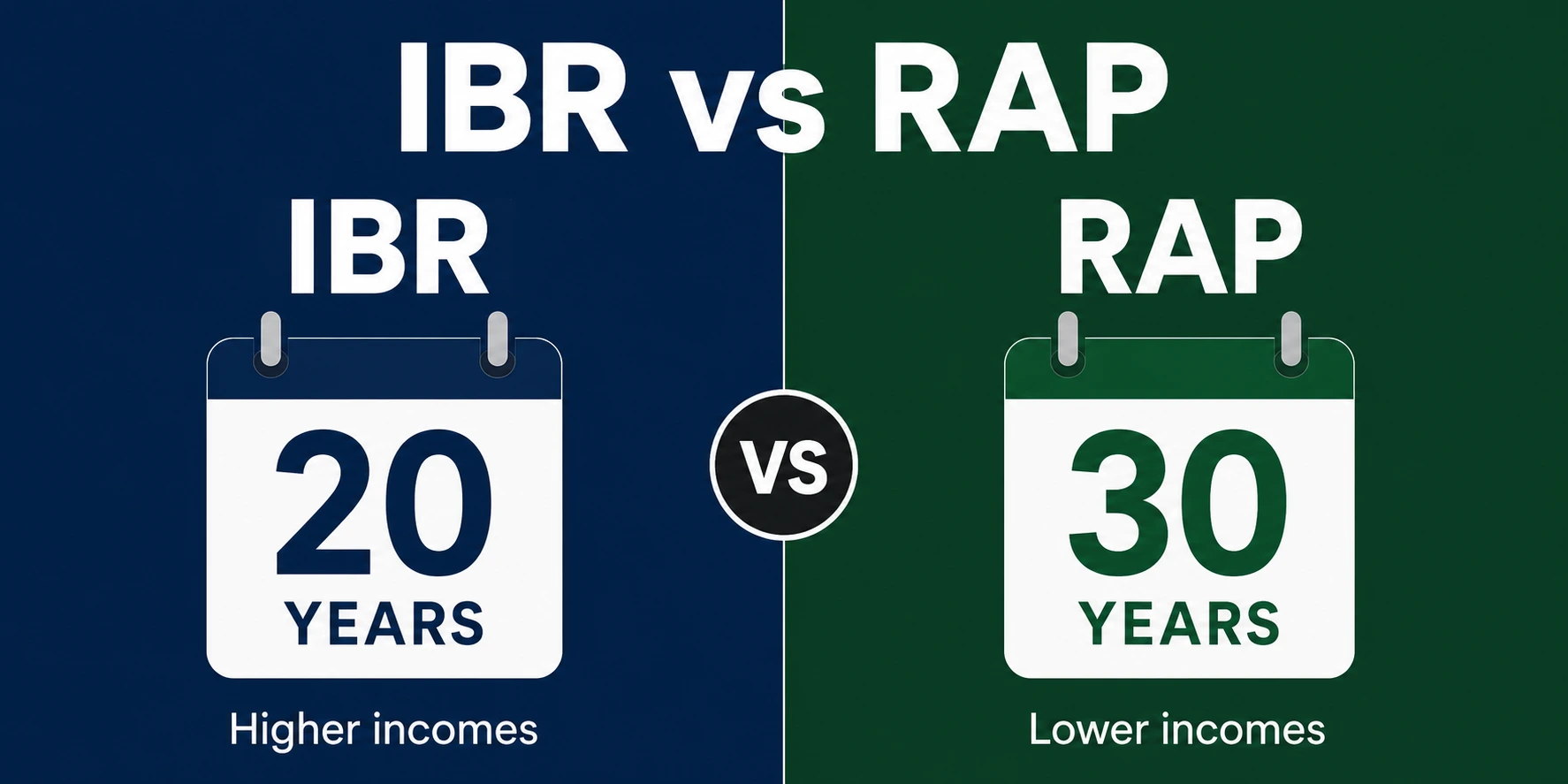
- RAP requires higher minimum payments and has a 30-year forgiveness timeline, making it more expensive for many borrowers compared to older plans.
- Parent PLUS borrowers will lose most IDR access under the new law unless they consolidate and enroll before July 1, 2026.
Changes for New Loans (Starting July 1, 2026)
Beginning July 1, 2026, federal student loan repayment rules will look very different for new borrowers.
Repayment options shrink: New loans disbursed on or after this date will have only two repayment choices:
- Standard Repayment Plan – fixed terms of 10, 15, 20, or 25 years (based on balance).
- Repayment Assistance Plan (RAP) – the new income-driven option with longer repayment timelines (up to 30 years of forgiveness).
Default assignment: If you don’t choose a plan, your loan will automatically be placed in the Standard plan.
Consolidation loans: Direct Consolidation Loans made after July 1, 2026, can only be repaid under Standard or RAP.
Excepted loans: Parent PLUS loans and any consolidation that pays off Parent PLUS debt will be classified as excepted loans—meaning they can only be repaid under the Standard plan. They won’t qualify for IBR or RAP.
Graduate PLUS loans: discontinued for new borrowers starting July 1, 2026.
New borrowing limits: Graduate students will face a $20,500 annual cap, with a lifetime borrowing limit of $257,500 (excluding Parent PLUS). Professional students (law, medical, etc.) have higher annual caps (up to $50,000), but all are subject to the overall federal cap for graduate and professional loans.
If you’re planning to start medical school in 2026, see our guide on how to pay for medical school with federal loans, RAP, and private options
Bottom line:
- Legacy IDR plans (SAVE, PAYE, and ICR) will close to new enrollments after July 1, 2026.
- Borrowers already in these plans must switch to IBR or RAP by July 1, 2028. If no choice is made, the Department will auto-assign you.
- To stay on track, make sure to recertify income annually—or enroll in automatic tax-based verification to avoid missed deadlines.
Parent PLUS Loan Borrowers: What’s Changing
New Parent PLUS loans: Any Parent PLUS loan first disbursed after July 1, 2026, will be an excepted loan—limited to the Standard Repayment Plan only.
Consolidations: Consolidation loans that include Parent PLUS debt will also be treated as excepted loans, losing eligibility for IBR or RAP.
No more loopholes: The “double consolidation” strategy that once gave Parent PLUS borrowers access to ICR is officially gone.
Existing Parent PLUS borrowers: If you’re already in ICR or another legacy IDR plan, you’ll need to move to IBR or RAP by July 1, 2028. Otherwise, you’ll be auto-assigned to RAP (if eligible).Why timing matters: If you need to consolidate to keep IDR access, you must do it before July 1, 2026. Because consolidation can take weeks, waiting until the last minute could mean losing your shot at flexible repayment.
New Repayment Assistance Plan (RAP)
The Repayment Assistance Plan (RAP), introduced under section 455(q) of the Higher Education Act of 1965, is a new income-based repayment option set to roll out starting July 1, 2026. It becomes one of two repayment plans available for new loans, alongside a standard repayment option.
When RAP Becomes Available
- RAP officially becomes available on July 1, 2026.
- Borrowers with “covered income contingent loans” (such as those on the old ICR plan) will begin repayment under their selected income-based plan—including RAP, 493C IBR, or another eligible plan—starting July 1, 2028, unless they opt in earlier.
- The Secretary of Education is required to offer RAP for all loans (not classified as “excepted loans”) made on or after July 1, 2026, including for borrowers who also have older loans.
- If a borrower with a new loan made on or after July 1, 2026, doesn’t select a plan, they’ll be placed on the Standard Repayment Plan by default.
- For older income-contingent loans, borrowers who don’t select a plan by July 1, 2028, will be enrolled into RAP (if eligible) or section 493C’s IBR plan.
- Borrowers can switch between RAP and the Standard Plan at any time.
Who Can Use RAP
- RAP is not available to repay “excepted loans.” This includes Federal Direct PLUS Loans made on behalf of a dependent student, or Federal Direct Consolidation Loans if their proceeds were used to pay off an excepted PLUS loan or another excepted consolidation loan.
- Borrowers with excepted loans must repay them separately from any loans eligible for RAP.
- For loans made on or after July 1, 2026, Federal Direct Consolidation Loans can only be repaid under either RAP or the Standard Plan
For borrowers navigating how a new 2026 federal loan can drastically alter their repayment trajectory, see our full guide on the RAP plan ‘poison pill’ effect.
How RAP Payments Are Calculated
Payments under RAP are based on your Adjusted Gross Income (AGI) and follow a tiered structure:
- Not more than $10,000: $120
- $10,001–$20,000: 1% of AGI
- $20,001–$30,000: 2% of AGI
- $30,001–$40,000: 3% of AGI
- $40,001–$50,000: 4% of AGI
- $50,001–$60,000: 5% of AGI
- $60,001–$70,000: 6% of AGI
- $70,001–$80,000: 7% of AGI
- $80,001–$90,000: 8% of AGI
- $90,001–$100,000: 9% of AGI
- Over $100,000: 10% of AGI
Borrowers can deduct $50 per dependent from their AGI when calculating payments. There’s a minimum payment of $10. If the total loan balance is less than the calculated monthly amount, the payment will be capped at the outstanding balance.
Loan Forgiveness Under RAP
After 360 qualifying monthly payments (30 years), any remaining principal and interest will be cancelled—provided the borrower’s most recent payment was under RAP. Payments that count include:
- On-time payments made under RAP
- On-time payments under the Standard Plan (as long as they meet or exceed what RAP would have required)
- Payments made under an Income-Contingent Repayment (ICR) plan—if the payment was at least what ICR required (this only applies to payments made before July 1, 2028)
- Payments under the original IBR plan (section 493C)
- Certain periods of deferment or forbearance, as defined by the Department
Assistance for Borrowers Struggling with Payments
- If a RAP payment doesn’t fully cover accrued interest, the unpaid interest won’t be added to the balance.
- If a RAP payment reduces the principal by less than $50, the Department will reduce the balance by an amount equal to: the lesser of $50 or the total amount paid that month, minus the amount of that payment applied to principal. This means the total principal reduction could be less than $50, depending on how much of the payment went toward interest or fees.
Verification and Documentation
- Borrowers may need to submit documentation if their AGI isn’t available or doesn’t reflect their current income.
- The Department of Education will set up procedures for annual income recertification, including options for automatic tax-based verification.
Additional Notes:
- For married borrowers filing separately, only their individual AGI is considered in the RAP payment calculation; joint filers use combined AGI.
- The minimum payment requirement ($10/month) means there are no longer $0 student loan bills, even for borrowers with very low income.
- Payments are always monthly amounts based on your annual AGI, divided by 12, corresponding to the tiered percentages.
What’s Being Phased Out
The introduction of RAP coincides with the wind-down of older repayment plans. For loans made after July 1, 2026, options like ICR and various Standard Repayment Plans will no longer apply. For these new loans, borrowers will choose between RAP and the Standard Plan.
Loan Forgiveness and Relief Provisions
- Discharges for Death or Disability: Beginning after December 31, 2025, student loan amounts discharged due to a borrower’s death or total and permanent disability will not be counted as gross income for tax purposes.
- Loan Rehabilitation Expanded: Borrowers will now be allowed to rehabilitate their FFEL, Direct, and Perkins Loans up to two times, doubling the previous limit. This takes effect on July 1, 2027. For loans made on or after that date, the minimum required monthly payment for a rehabilitated loan will be $10.
- Delay in Borrower Defense and Closed School Discharge Rule Changes: New rules governing borrower defense to repayment and closed school discharges will not take effect until July 1, 2035. Until then, the Department will revert to the regulations that were in place as of July 1, 2020, for loans made before July 1, 2035.
- Increased Servicing Funding: Congress has appropriated $1 billion to the Department of Education to fund administrative costs related to servicing federal student loans. This funding will remain available until fully spent.
Where We Are Now in the Legislative Process
This table summarizes the steps involved in passing the reconciliation bill and where things now stand:
| Step | Status | What It Means |
| Committee drafting | Done | Bill was created and finalized by Republican lawmakers |
| Parliamentarian review | Done | Senate rules advisor flagged provisions that didn’t meet reconciliation rules |
| Bill revisions | Done | Republicans updated the bill to comply with those rules |
| Senate procedural vote | Done (6/29) | Bill cleared the vote needed to move to full Senate debate |
| Full Senate debate | Done | Senate debated the revised bill before holding a final vote |
| Final Senate vote | Done (7/1) | Bill passed with a simple majority (Republicans hold 53 seats) |
| House of Representatives | Done (7/3) | House voted to approve the final Senate version |
| Presidential signature | Done (7/4) | President Trump signed the One Big Beautiful Bill into law on July 4, 2025 |
Want Help Navigating These Changes?
Worried about how this affects your loans and long-term finances?
Chatting with a Certified Financial Planner can help you evaluate how these changes may impact your repayment strategy, retirement planning, and overall financial wellness.
Book a consult — we’ll walk through your options, review your current plan, and help you make smart, forward-looking decisions.
Further Reading:
Abolishing the Department of Education: Trump, Project 2025, and the Uncertain Future of Federal Student Loans – Eliminating the Department of Education won’t mean student loan forgiveness for existing borrowers, but it could create major headaches for the system.
About the Author

Pedro Gomez is the new Student Loan Sherpa and a Certified Financial Planner™ with over a decade of experience helping clients navigate complex financial decisions. He is the founder of Global Financial Plan, where he writes about international living, geoarbitrage, and strategies for retiring young, and also leads Brickell Financial Group, a registered investment advisory firm focused on accelerating financial freedom.
Pedro is the architect behind the “12 Levels of Financial Freedom” framework and blends student loan strategy with long-term planning, tax efficiency, and investing. His work is especially geared toward upwardly mobile professionals, entrepreneurs, and those looking to design a life beyond the default path.
Pedro is available for strategy sessions and press inquiries.