

If you’re carrying large federal student loans and thinking about borrowing again after July 1, 2026, the new RAP rules under the One Big Beautiful Bill Act (OBBBA) can permanently change how your entire balance is repaid.
This article breaks down the “poison pill” effect. Not the politics. Not the headlines. The mechanics.
This is niche content for borrowers with:
- Large pre-2026 federal balances ($200k+)
- High earning potential ($200k+ post-training)
- A need for additional federal borrowing on or after July 1, 2026
For most people, RAP (Repayment Assistance Plan) is a strong safety net. But for a small group of high-debt professionals, how you choose to repay that final sliver of debt can change your lifetime cost by six figures. This isn’t just about a new loan; it’s about whether you inadvertently trigger a move that strips away your New IBR protections and extends your repayment timeline by a decade.
Important eligibility note: Borrowing Limits and the Legacy Provision
This scenario only applies if you qualify for the OBBBA Legacy Provision.
Under the new law, most borrowers face strict lifetime federal borrowing caps. However, if you had an active federal loan disbursed before July 1, 2026 and remain in the same degree program, you may be allowed to continue borrowing under prior Cost of Attendance rules for a limited period (generally up to three years or until graduation).
If you are starting a new program after July 1, 2026 (including a new specialty, second degree, or fellowship treated as a new program), the legacy exception does not apply. In that case, federal borrowing may be capped or unavailable, and the strategy discussed in this article may not be an option at all.
For a deeper dive into how the new borrowing caps work and what they mean for medical and professional students specifically, we recommend reading ourMedical School Loans Guide, which walks through the cap calculations and program-specific implications in detail. For the latest regulatory updates on RAP and the July 1 deadline as they develop, see our Student Loan News & Updates 2026.
The “Poison Pill” Explained
Here’s what often gets misunderstood:
Borrowing a federal loan after July 1, 2026 does not automatically force your older loans onto RAP.
But there are two ways to trigger the poison pill:
Trigger #1: Consolidation (Irreversible)
When you consolidate pre-2026 and post-2026 loans into a Direct Consolidation Loan, the entire balance is governed by the newer repayment framework. This is permanent—you cannot unconsolidate loans.
Trigger #2: Plan Alignment (The Subtle One)
Under OBBBA, post-2026 loans are restricted to RAP or Standard, and servicer systems are designed around portfolio-level plan alignment. In practice, this makes mixing RAP and New IBR across the same borrower extremely difficult to maintain long-term.
What this means:
- If you place your post-2026 loan on RAP (to access the interest subsidy), the system is designed to align your entire federal portfolio onto RAP
- Mixing RAP and New IBR on separate loans conflicts with OBBBA’s requirement for a unified IDR election across all federal loans
- The only way to preserve New IBR on your older loans is to keep the new loan on a Standard (non-IDR) plan
Think of it like this:
You have $350,000 in pre-2026 federal loans on New IBR (20-year forgiveness, payment cap).
You borrow $50,000 after July 2026 to finish school.
Your actual choices are:
- Keep loans separate AND keep the $50k on Federal Standard → Preserve New IBR on the $350k
- Put the $50k on RAP OR consolidate everything → Entire balance moves to RAP (30-year timeline, no fixed dollar payment cap—payments continue rising as income increases)
The poison pill isn’t just consolidation. It’s enrolling the new post-2026 loan in any IDR plan, which forces portfolio-level alignment.
New IBR vs. RAP: Understanding the Payment Cap Difference
Both New IBR and RAP have caps, but they work very differently:
- New IBR cap: Your payment stops rising once it hits what your 10-year Standard payment would have been. This is a fixed dollar ceiling and is often much lower for high earners.
- RAP does not have a fixed dollar payment cap. Payments are set as a percentage of income, so as income rises, the maximum payment rises with it. In contrast to New IBR, there is no point where payments stop increasing in nominal dollars.
This difference is one of the biggest long-term cost drivers for high-income borrowers.
For high earners with large balances, New IBR’s dollar-based cap is usually much lower, creating significant savings over 20–30 years.
Additional RAP Features:
During low-income years (residency, fellowship):
- 100% interest subsidy if payments don’t cover accruing interest
- This prevents balance growth and provides meaningful relief early
The tradeoff: Great protection during training, but higher lifetime cost once income rises due to the longer timeline and percentage-based cap.
With the mechanics in place, the cost differences become easier to see when you run the numbers.
The Math
Scenario: High-Debt Professional Track
Profile:
- Existing federal debt: $350,000 (pre-2026, currently on New IBR)
- Final semester need: $50,000 (post-July 1, 2026, Grad PLUS)
- Long-term income: $200,000+
- Goal: Minimize lifetime cost (not pursuing PSLF)
Note: Payment examples are illustrative and assume simplified income scenarios. Actual payments depend on household size, deductions, and final RAP regulations.
Option A: Consolidate Everything → RAP Applies to All
The Move: Consolidate $350k + $50k into a single Direct Consolidation Loan
- Total balance: $400,000
- Repayment plan: RAP (30-year timeline)
- Payment: ~$1,667/month at $200k income; ~$3,333/month at $400k income
- Key feature: 100% interest subsidy during residency if payments don’t cover accruing interest
Best for: PSLF-eligible borrowers. PSLF still forgives after 10 years, and RAP’s interest subsidy during training years makes this combination the cheapest path by far.
Drawbacks for non-PSLF borrowers:
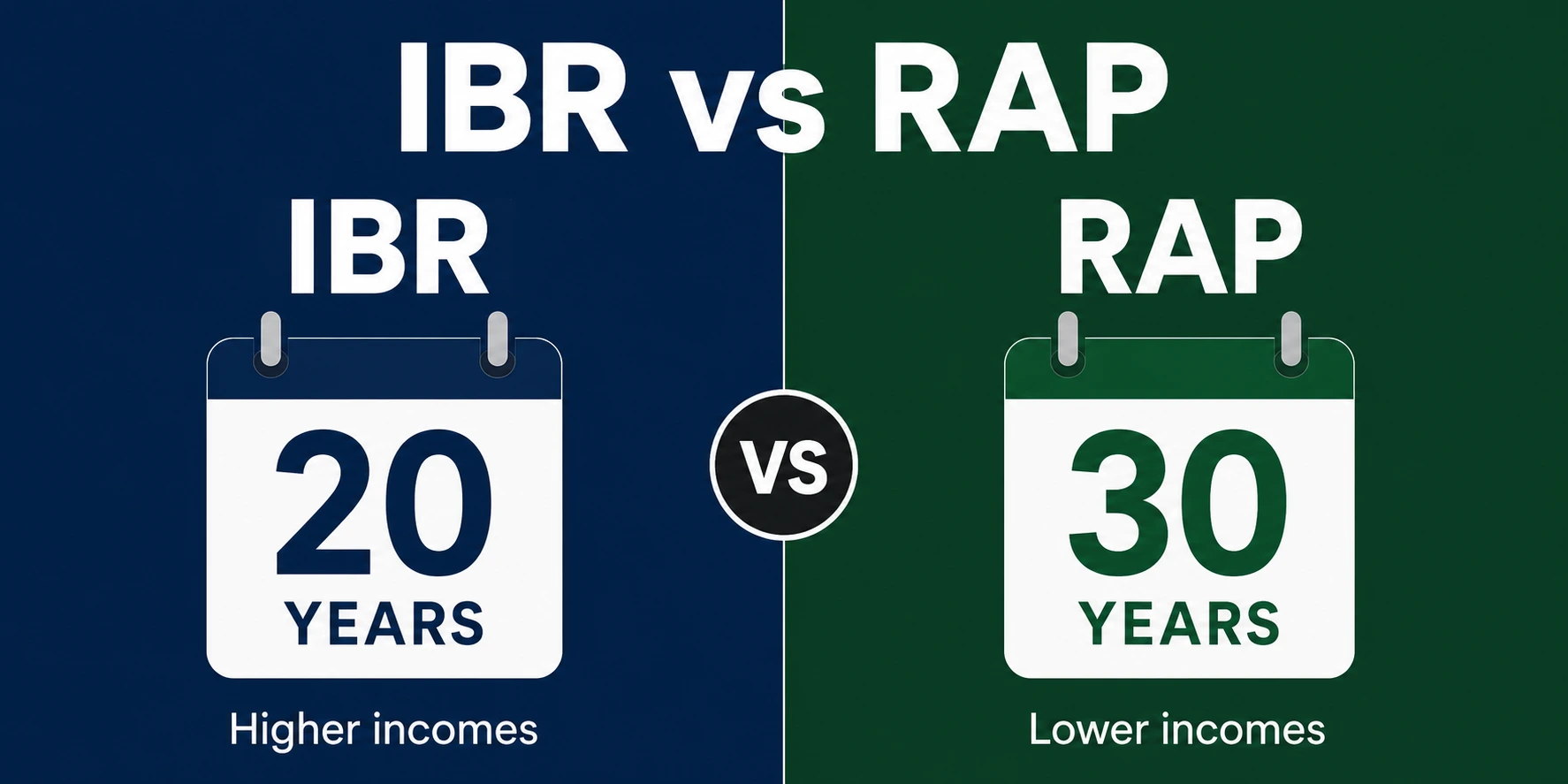
- Adds 10 years compared to New IBR (30 years vs. 20 years)
- No payment cap—payments continue rising with income
- Highest long-term cost for high earners not pursuing PSLF
Option B: Federal Standard “Quarantine” (Lowest Total Cost)
The Move: Keep $350k on New IBR and put the $50k on Federal Standard 10-Year Level Plan
- $350k: New IBR (20-year timeline, payment capped)
- $50k: Federal Standard (10-year Level term)
- Combined payment: ~$1,667/month (IBR) + ~$630/month (Standard) = ~$2,300/month
Technical requirements:
- Must request the Level 10-year term (not Tiered Standard, which escalates payments over time and often extends beyond 10 years)
- Never enroll the $50k in any IDR plan (Plan Alignment rule would force the $350k onto RAP)
- Keep loans permanently separate (no consolidation)
This structure tends to produce the lowest lifetime cost for high earners who can sustain higher monthly payments and are willing to actively manage their setup.
Drawbacks:
- High-maintenance (requires annual monitoring)
- Higher monthly cash flow needs
- The $50k loan is technically PSLF-eligible, but would be fully repaid within 10 years, resulting in $0 forgiven
Operational Pitfall: The “Standard Plan” Default Trap
Option B only works if the $50k loan is placed on the 10-year Level Standard plan. In practice, servicers often default high-balance borrowers into Tiered or extended Standard plans (25–30 years).
If that happens, the $50k loan may accrue more interest than expected, quietly eroding the cost advantage that makes Option B attractive in the first place. This isn’t a theoretical edge case. It’s a common servicer behavior that borrowers need to actively override.
Option C: Private Loan Quarantine
The Move: Take $50k as a private student loan; leave $350k untouched on New IBR
- $350k: New IBR (20-year timeline)
- $50k: Private loan (10–20 year term at ~8%)
- Combined payment: ~$1,667/month (IBR) + ~$418/month (Private) = ~$2,085/month
Best for: Borrowers who want to preserve IBR but can’t manage the higher Standard payment
Drawbacks:
- Higher lifetime interest than Option B
- Limited federal protections on the $50k
- Total cost often ~$25k–$30k higher than Federal Standard under typical private loan rates and terms

On paper, Option B wins the spreadsheet. In real life, spreadsheets don’t deal with servicers.
The Hidden Risks of Option B (Why the “Cheapest” Path Is Also the Most Fragile)
Option B produces the lowest lifetime cost on paper. In practice, it is the most failure-prone strategy.
This path only works if you execute cleanly for a decade or more. The risks aren’t theoretical. They’re behavioral and administrative.
Risk #1: Servicer Error (Very Real)
Servicers routinely:
- Auto-enroll borrowers into IDR plans
- “Optimize” plans during recertification
- Default borrowers into longer Standard plans
If your $50k loan is accidentally placed on RAP (or any IDR), plan alignment kicks in and your entire $350k balance is forced onto RAP — unless you catch and reverse it immediately during the disclosure / correction window.
If this change goes unnoticed or unchallenged, the move is permanent. This isn’t malicious. It’s paperwork roulette.
Risk #2: Life Happens
Option B assumes you can sustain:
- Higher monthly payments
- No career interruption
- No income volatility
- No need for flexibility
If you take a lower-paying job, go part-time, experience burnout, take parental leave, or step away from clinical work, you may need IDR flexibility on the $50k loan. The moment you use it, you lose New IBR protection on the $350k balance.
Risk #3: Recertification Drift (and Automation Risk)
This strategy requires active, manual oversight every year:
- Confirming each loan’s repayment plan
- Reviewing servicer changes and “helpful” plan switches
- Declining any prompts to enroll the $50k loan in IDR
- Opting out of auto-recertification and automated income pulls
The Department of Education is moving toward automatic income data sharing with the IRS and automated plan “simplification.” If you set this on autopilot, servicer workflows may default toward aligning all eligible loans onto RAP unless the borrower actively intervenes. That kind of administrative cleanup can trigger the poison pill unless caught and reversed immediately during the disclosure window.
One missed recertification cycle or one unnoticed plan change can undo a 20-year strategy.
Risk #4: Policy Drift
This approach assumes:
- New IBR remains available for legacy borrowers
- The 10-year Level Standard option remains accessible
- Servicers continue to allow plan separation
Congress can change any of this. You’re building a multi-decade plan on rules that may not survive the next budget cycle.
The “Manual Override” (Non-Optional):
To execute Option B correctly, the borrower must manually select which loans are included each time they submit an IDR Request. This means explicitly excluding the post-2026 $50k loan from any IDR enrollment.
If the borrower selects “Apply to all loans” or uses auto-recertification, servicer systems may sweep the legacy $350k into RAP to standardize the account. That triggers the poison pill unless caught and reversed immediately during the disclosure window.
Translation: Option B only works if you actively override the system every year. Autopilot breaks the strategy.
How the Tradeoffs Break Down (Zooming Out)
By this point, the math is clear. What actually separates these options isn’t just total cost. It’s the tradeoff between flexibility, operational risk, and how much administrative babysitting you’re willing to tolerate for the next 10–20 years.
Option A (RAP for Everything): Lowest friction, highest long-term cost for non-PSLF borrowers. You’re paying for simplicity and downside protection. The interest subsidy smooths out the early years, the system handles everything automatically, and you’re not fighting servicers or manually managing loan cohorts. If your career path is uncertain or you value not having to think about this for two decades, that peace of mind has a price—and for PSLF-eligible borrowers, it’s actually free.
Option B (Federal Standard Quarantine): Lowest lifetime cost, highest execution risk. Financially elegant, operationally fragile. On paper, this saves tens of thousands. In practice, it only works if you execute flawlessly for a decade—no servicer errors, no missed recertifications, no autopilot moments. One administrative slip and the entire strategy collapses. You’re optimizing for cost but accepting complexity and vigilance as the tax.
Option C (Private Loan Quarantine): Middle ground. You preserve IBR protections on the large balance but trade federal safeguards and higher interest for immediate cash-flow relief. It’s the “I can’t handle the Standard payment but refuse to trigger RAP” option. More expensive than Option B over a career, but less fragile. You’re buying flexibility on the small loan while keeping the big balance safe.
How These Strategies Map to Common Borrower Profiles
In practice, these strategies tend to cluster around different borrower profiles:
- Borrowers pursuing PSLF tend to benefit most from RAP consolidation, since forgiveness dominates lifetime cost.
- High-income private-sector borrowers tend to favor preserving New IBR, even if it requires more administrative work.
- Borrowers with cash-flow constraints often trade higher lifetime cost for lower monthly pressure by isolating new debt outside the federal system.
These aren’t recommendations. They’re the common patterns that emerge when you map the mechanics of each option to real-world constraints.
Managing Uncertainty: How Future Income Impacts Lifetime Cost
Your lifetime repayment depends heavily on variables that are difficult to predict:
- Will your income be $150k, $250k, or $400k?
- Will you change careers or take time off?
- Will you file taxes jointly or separately?
- Will you live in a high-cost city?
These factors don’t automatically break your repayment strategy, but they can swing your total cost by tens of thousands. Planning for them—through modeling, careful tracking, and scenario analysis—helps you avoid unpleasant surprises.
If you don’t want to wake up five years from now realizing a servicer “helped” you into a worse plan, our newsletter walks through these changes in plain English as rules evolve.
FAQs
No. Simply borrowing a new federal loan does not automatically move your pre-2026 loans onto RAP. The “poison pill” is triggered by either consolidating old and new loans together or enrolling the new post-2026 loan in an IDR plan like RAP, which forces portfolio-level plan alignment.
Yes, but only if you keep the new post-2026 loan on a non-IDR plan, such as the 10-year Level Standard plan, and avoid consolidation. Enrolling the new loan in RAP or another IDR plan can force all loans onto RAP.
New IBR has a fixed dollar payment cap based on the 10-year Standard payment. RAP does not. RAP payments continue to rise with income, and the repayment timeline is longer. For high earners, that usually translates into significantly higher lifetime repayment.
Yes. RAP can be very favorable during low-income years because of its 100% interest subsidy when payments don’t cover interest. For borrowers pursuing PSLF, RAP combined with forgiveness after 10 years can also be the lowest-cost path overall.
About the Author

Pedro Gomez is the new Student Loan Sherpa and a Certified Financial Planner™ with over a decade of experience helping clients navigate complex financial decisions. He is the founder of Global Financial Plan, where he writes about international living, geoarbitrage, and strategies for retiring young, and also leads Brickell Financial Group, a registered investment advisory firm focused on accelerating financial freedom.
Pedro is the architect behind the “12 Levels of Financial Freedom” framework and blends student loan strategy with long-term planning, tax efficiency, and investing. His work is especially geared toward upwardly mobile professionals, entrepreneurs, and those looking to design a life beyond the default path.
Pedro is available for strategy sessions and press inquiries.


I am on the old IBR what will be better and can I switch the new IBR or RAP consolidated loans and and its a big amount . Is the old IBR 20 yers or 30?
Old IBR requires 25 years of repayment (300 qualifying payments) before forgiveness. It is not a 20-year plan like New IBR or PAYE, and it is not a 30-year plan like the new Repayment Assistance Plan (RAP).
Because you have a large student loan balance, the key question isn’t simply which plan is “better.” Each option has advantages and disadvantages, and the right choice depends heavily on your future income trajectory and repayment goals.
Can you switch to New IBR?
No. New IBR is limited to borrowers who first became federal student loan borrowers on or after July 1, 2014. Since you are already on Old IBR, you do not meet that requirement. Consolidating your loans would not change your eligibility status.
Can you switch to RAP?
Yes. Assuming RAP launches as scheduled, borrowers currently on Old IBR should have the option to enroll. However, there are important tradeoffs.
Under RAP, forgiveness occurs after 30 years of repayment rather than 25 years under Old IBR. RAP also does not include a payment cap. By contrast, Old IBR limits your monthly payment to the amount you would have paid under the 10-year Standard Repayment Plan when you entered IBR.
That payment cap can be extremely valuable for some borrowers. For example, a medical resident may have relatively low income today but could see earnings increase dramatically after training. Under Old IBR, the payment cap limits how high monthly payments can rise. Under RAP, payments could continue increasing along with income and potentially exceed what would have been owed under a standard repayment schedule.
On the other hand, RAP includes benefits that Old IBR does not. RAP waives unpaid interest, preventing negative amortization, and includes a government principal-matching benefit. For borrowers whose incomes are expected to remain relatively modest for a long period of time, those features could be meaningful.
In other words, borrowers expecting substantial future income growth may place a high value on Old IBR’s payment cap, while borrowers focused on interest control may find RAP’s subsidies attractive. Which feature matters more depends on the borrower’s specific circumstances.
One additional consideration is consolidation.
Under current law, consolidating federal loans on or after July 1, 2026, may eliminate access to IBR, PAYE, and ICR for the resulting consolidation loan, leaving RAP and certain non-IDR repayment options as the primary choices going forward.
Additionally, because the one-time IDR adjustment has ended, borrowers who consolidate now generally receive a weighted-average payment count rather than preserving the highest count among the loans being consolidated.
The most important takeaway is that the decision is not simply Old IBR versus RAP. The analysis depends on factors such as your current income, expected future income, loan balance, family size, forgiveness timeline, and how much value you place on features like the IBR payment cap versus RAP’s interest and principal benefits.