

Update – The Bill Is Now Law:
The One Big Beautiful Bill (OBBB) was officially signed into law on July 4, 2025, bringing major changes to repayment plans, forgiveness options, and loan eligibility. We’ve broken it all down in plain English in our latest guide:
What the One Big Beautiful Bill Means for Your Student Loans in 2025
Senate Republicans have introduced a comprehensive student loan reform plan as part of the “One Big Beautiful Bill Act.” The education section of this legislative draft outlines wide-reaching changes to student loan repayment, borrowing limits, and school accountability. While presented as a more moderate approach than the House version, the Senate proposal still includes major structural changes that could significantly affect borrowers.
Key Takeaways
- Elimination of Existing IDR Plans: The proposal ends access to all current income-driven repayment (IDR) plans—including SAVE, PAYE, REPAYE, and ICR—for new borrowers. These would be replaced by a new “Repayment Assistance Plan” (RAP) with standardized terms.
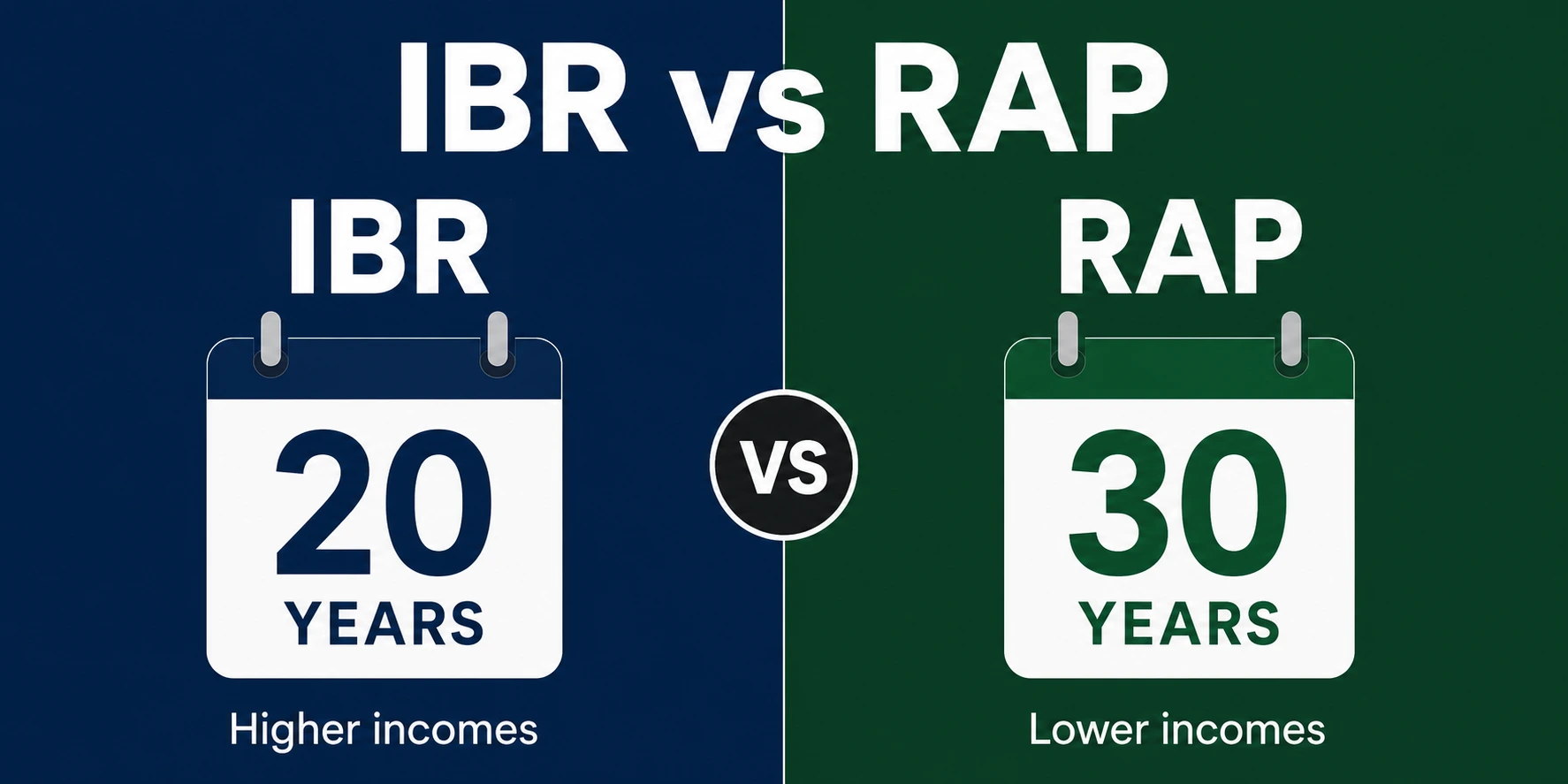
- Only Two Repayment Options Going Forward: Borrowers taking out new loans after July 1, 2026, would choose between a 10-year fixed repayment plan or RAP. RAP would base payments on a borrower’s adjusted gross income (AGI), ranging from 1% to 10%, with a minimum of $10 per month. The plan includes interest subsidies and modest principal matching for on-time payments. Forgiveness would be available after 30 years (360 payments).
- RAP and Spousal Income: The Senate bill defines AGI for RAP as the income of the borrower and, where applicable, the borrower’s spouse—but it does not clarify when spousal income is excluded. Without language explicitly allowing married borrowers to file separately and exclude spousal income, the bill may effectively eliminate married filing separately as a planning strategy under RAP, raising concerns about a potential marriage penalty.
- Grad PLUS Eliminated; Parent PLUS Capped: The bill ends new Grad PLUS loans issued after July 1, 2026, and sets a $65,000 lifetime borrowing cap per dependent student for Parent PLUS loans. It also introduces new annual and aggregate borrowing limits for other federal loan types.
If you’re wondering how to cover the remaining costs once Grad PLUS loans are no longer available, our guide to private loans for medical school in 2026 walks you through your options, compares top lenders, and offers strategies to reduce borrowing. - Accountability Rules for Schools: Instead of imposing financial penalties on institutions for borrower defaults, the proposal would remove access to federal aid from programs whose graduates consistently earn less than individuals with only a high school diploma.
- Changes to Pell Grant Eligibility: The Senate version avoids stricter credit-hour requirements proposed in the House bill. However, it does set a threshold using the Student Aid Index (SAI) to exclude higher-income students from eligibility. It also proposes $10.5 billion in additional funding for fiscal year 2026 to address the program’s projected shortfall.
What Happens Next: Understanding the Legislative Process
At this stage, the Senate GOP proposal is still a draft—it has not yet been formally introduced or passed by the Senate. This means it is not yet law, and many of its provisions could be revised, delayed, or removed altogether during the legislative process.
Here’s how the process typically unfolds:
- HELP Committee Review and Vote
The committee will formally introduce the bill, review its language, and potentially revise it before voting to advance it to the full Senate. - Full Senate Consideration
If approved by the committee, the bill would go to the full Senate for debate, amendments, and a vote. It would need a simple majority to pass if done through budget reconciliation. - House of Representatives Review
If passed by the Senate, the bill then heads to the House. Lawmakers there may accept it, amend it, or propose their own version. - Reconciliation and Final Approval
If there are differences between the House and Senate versions, they must be reconciled into a single unified bill. - Presidential Signature
Once both chambers pass the final version, it goes to the President to be signed into law.
Why it matters:
Some provisions—like the elimination of IDR plans—are written to take effect immediately upon enactment. That makes the pre-passage window crucial for borrowers who want to lock in options under the current system.
Implementation Timeline
While the new borrowing caps would begin on July 1, 2026, not all changes would wait until that date. The most immediate impact would be on Income-Contingent Repayment (ICR) plans.
If the bill passes, ICR would be eliminated immediately for new enrollees. Parent PLUS borrowers who are currently using ICR after double consolidation would be automatically transitioned to the Income-Based Repayment (IBR) plan as of the bill’s enactment date.
Other IDR plans like SAVE, PAYE, and IBR would remain available for loans disbursed before July 1, 2026. These plans would stay open to existing borrowers until the new repayment system fully takes over.
For new loans disbursed on or after July 1, 2026, the only available repayment options would be:
- A 10-year standard repayment plan
- The new Repayment Assistance Plan (RAP) (except for Parent PLUS loans, which would only qualify for the Standard Plan and would not be eligible for RAP, even if consolidated)
Sherpa Note:
While these options technically remain for existing loans, court challenges in 2025 have already paused certain SAVE and PAYE plan features, including new enrollments and forgiveness processing. IBR remains the most stable option because it is written directly into federal law.
Parent PLUS Borrowers: The Most at Risk
Of all the changes proposed, none are more concerning than those impacting Parent PLUS borrowers. These families could face some of the harshest consequences if the bill becomes law.
Key concerns include:
- Parent PLUS borrowers currently rely on consolidation into a Direct Loan to access Income-Contingent Repayment (ICR).
- The Senate bill would eliminate ICR for new enrollees immediately upon enactment.
- Parent PLUS borrowers would be excluded from the new Repayment Assistance Plan (RAP).
- Without ICR or RAP, remaining options would include standard, extended, or graduated plans—none of which are income-driven or offer forgiveness.
- The bill sets a $65,000 aggregate cap on Parent PLUS loans per student.
Borrowers should consider acting promptly:
- Those who have not yet consolidated or enrolled in ICR risk losing access to affordable repayment.
- Fixed repayment plans can be unaffordable and lack any forgiveness option.
We strongly recommend that affected borrowers schedule a consultation with the Student Loan Sherpa team as soon as possible to evaluate their situation and make any necessary changes before the bill passes.
Bottom Line
This bill has the potential to reshape federal student loan policy for years to come. Borrowers should stay informed and take proactive steps now, especially if they rely on current IDR plans or hold Parent PLUS loans.
As always, we’ll continue to monitor developments closely and provide timely updates as the legislation progresses.
Student Loan Interest Deduction FAQ
No, the Senate GOP proposal is still a draft. It has not been formally introduced or passed into law. Until it goes through the full legislative process, including Senate and House approval, nothing is changing yet.
Some changes (like ending access to current IDR plans) would take effect immediately once the bill is signed into law. Other changes, like the launch of the new Repayment Assistance Plan (RAP) and new borrowing caps for Parent PLUS loans, would begin July 1, 2026.
Eligibility is based on when you are officially enrolled, not just when you submit your application. According to the current bill language, only borrowers actively on ICR at the time the bill is signed into law will keep access to income-driven repayment through the new modified IBR or have the option to switch to RAP.
The safest move appears to be getting into repayment on ICR before the bill passes. Forbearance or deferment may not protect your access under the new rules. Making at least one qualifying payment now could help you stay eligible if the bill passes.
Yes, you can switch from SAVE to ICR, but it can take weeks depending on your loan servicer. The draft bill doesn’t directly address switching between plans like SAVE and ICR.
As for PSLF:
Generally, you need to be actively making payments for them to count toward PSLF. Time spent in SAVE forbearance probably won’t qualify for PSLF credit. The bill doesn’t specifically talk about SAVE forbearance, but under current PSLF rules, forbearance periods typically don’t count unless specifically noted.
If you have Parent PLUS loans (even double consolidated), staying on SAVE could put you at risk of losing access to IDR options if the bill passes. Many borrowers are moving quickly to switch to ICR and start repayment. If you don’t have Parent PLUS loans, the urgency is lower, but it’s smart to monitor updates.
If the bill passes, borrowers on existing income-driven plans may be automatically shifted to the new RAP or a revised IBR, depending on the final bill details and how the Department of Education implements the changes. The bill specifically mentions automatic transitions for borrowers in income-contingent plans (like ICR), but it’s not yet clear how plans like SAVE will be handled.
Grad PLUS loans are being eliminated for new borrowers starting July 1, 2026. No new Grad PLUS loans will be issued after that date.
Parent PLUS loans will still be available but with strict new limits. Starting July 1, 2026, borrowing will be capped at $20,000 per year and $65,000 total per borrower. Existing loans for both programs will remain and are not affected.
There’s a real possibility the bill could pass with provisions that immediately cut off access to ICR and other plans for Parent PLUS borrowers. Waiting could mean losing out on income-based repayment and forgiveness options forever. Acting now can lock in protections.
About the Author

Pedro Gomez is the new Student Loan Sherpa and a Certified Financial Planner™ with over a decade of experience helping clients navigate complex financial decisions. He is the founder of Global Financial Plan, where he writes about international living, geoarbitrage, and strategies for retiring young, and also leads Brickell Financial Group, a registered investment advisory firm focused on accelerating financial freedom.
Pedro is the architect behind the “12 Levels of Financial Freedom” framework and blends student loan strategy with long-term planning, tax efficiency, and investing. His work is especially geared toward upwardly mobile professionals, entrepreneurs, and those looking to design a life beyond the default path.
Pedro is available for strategy sessions and press inquiries.


Another major update, now the Supreme Court shot down nationwide injunctions so theoretically anyone on SAVE who is in a state not participating in the lawsuit can go back to repayment and stay on the plan. This ensures that it will be up to the Supreme Court to make a decision should they decide to take the case.
Great update! Thanks for sharing. Will be following up more on this.
Major update: The Senate Parliamentarian is blocking student loan plan changes for current borrowers. Senate majority leader is going with recommendation. Certainly a good idea if they are looking to pass the bill quickly but this is still bad news for those going to college.
On IBR why do they unfairly treat older borrowers differently with loans before 2014 by tacking an extra 5 years on the term? What’s so special about 2014? Why are they dividing borrowers up into groups instead of applying the same rules for everyone?
Great point, Jeff. The 2014 IBR cutoff is a classic case of budget politics, not borrower fairness.
Back in 2010, Democrats controlled the White House and both chambers of Congress—basically the mirror image of today’s GOP-controlled House and Senate. But they didn’t have enough Senate votes to overcome a filibuster. So they used budget reconciliation, a special process that lets certain bills pass with a simple majority.
Here’s the catch: Under Senate rules (the Byrd Rule), reconciliation can only include provisions that have a direct budget impact—it can’t be used for sweeping policy changes that don’t affect federal spending or revenue.
So when Democrats created the more generous IBR (10% payment / 20-year forgiveness), they couldn’t go “willy nilly generous” for everyone. To keep costs low and make the bill passable, they delayed the benefit until 2014 and limited it to new borrowers—shrinking the number of people who’d qualify during the 10-year budget window.
Fast forward to today, and the GOP is using the same reconciliation playbook—but in reverse: limiting borrower benefits and setting new cutoffs (2024, 2026) to control future costs.
Bottom line: Borrowers keep getting divided into groups not because of fairness—but because that’s how Congress games the budget rules to get student loan laws passed.
Perhaps the one saving grace for old IBR is its placement in statue in 2007, which of course can change but it potentially has a stronger standing and it came in during the Bush administration. The irony of the RAP plan is the Senate making it into a worse version of REPAYE by saying if it was “good enough during Obama’s presidency, it’s good enough for now”. Yet it would drastically increase payments and most married couples will be paying 10% of their combined income. If old IBR has anything changed that takes away filing separate even with that provision being in law, many, many people will default. I would be surprised if they do (yet still concerned they could) as they want to put everyone back to old IBR who is a current borrower not in repayment I.e. in SAVE forbearance. Crazy times and only means when Dems have the presidency, House, and Senate the pendulum will swing heavily in the opposite direction.
Totally with you on this. Two recent WSJ articles really highlight how bad the timing and economic impact of these student loan cuts could be (in the process of writing a new blog on this):
Over 5.8 million borrowers are already 90+ days delinquent, and the Department of Education expects millions more to default by the end of this summer as collections, including wage garnishments, ramp back up: WSJ: Student Loan Wage Garnishment
On top of that, average credit scores for delinquent borrowers have dropped about 60 points, and young adults (18-24) are cutting spending sharply—13% less year-over-year in the first few months of 2025: WSJ: Student Loans and the Economy
If this were part of a broad, balanced effort to reduce the deficit—fine. But here’s what’s crazy: we’re aggressively cutting education, healthcare, and environmental programs… all while increasing defense spending, which already sits close to $900 billion a year. This is larger than the entire economy of Switzerland.
We’ve got two oceans and two allies (Canada and Mexico) as buffers, yet we’re acting like we’re under constant imminent threat to justify increased defense spending at any cost. Meanwhile, Americans are struggling with a higher cost of living, declining credit health, and growing default risk—all of which drag down productivity and economic growth.
Sure some sectors of the economy will benefit from this but I would argue at the cost of sectors that are much more fundamental to our future growth in terms of productivity. So to your point I see the pendulum swinging hard left again. But this is not the answer either.
$900 billion going towards a sector who is focused on developing advanced tools for destruction instead of human capital and infrastructure is not putting America on the right path. Hence why I founded Globalfinancialplan.com a blog that talks about geoarbitrage and reaching financial independence so you are not captive to a system that is working for these Super PACs who have our politicians bought instead of the future of the American people. Anyway I will get off my soap box as I am deviating from Student Loan topics…Don’t want to offend anyone.
Great analysis, Pedro! I’ll check out the blog and pass it on. Thanks!
Sam
Actually, I have read the Senate version has a cap for old IBR. Hard to keep up..
Sam
Totally understandable, it’s a lot to keep track of right now. And the worst part is that there may still be a few surprise adjustments in store for us.
I have confirmed directly from the Senate version of the bill that it does not place a cap on payments for borrowers remaining on old IBR. Old IBR would continue to calculate payments at 15% of discretionary income, with no cap tied to the 10-year standard.
They are basically reverting back to the 2007 IBR version with a few nuanced differences. But the core math is the same.
If I’m understanding this correctly, this would affect new borrowers. What advice do you have for those of us who signed up for SAVE but are now in forbearance?
Great questions, John. You’re right that the Senate bill draws a line for “new borrowers” after July 1, 2026—but unfortunately, it doesn’t stop there. It would also impact existing borrowers, especially those currently on SAVE or in forbearance.
Here’s the key issue: The bill explicitly eliminates the SAVE plan. So even if you’re already enrolled (or currently in forbearance tied to SAVE), the benefits you signed up for—like the lower payment rate and earlier forgiveness—would disappear.
For borrowers like you, with loans disbursed before July 1, 2026, the bill would push most people into an amended IBR plan, which comes with 15% payments, no payment cap, and a longer forgiveness timeline (20 or 25 years depending on your degree level). The only “automatic transition” the bill specifically spells out is for people on ICR. For SAVE borrowers, you’d likely have to proactively pick a new plan—or risk defaulting into one.
If this passes, acting quickly to understand your new repayment options would be critical. That’s exactly the kind of thing we help borrowers map out in a strategy session—especially when the rules keep shifting mid-game.
Good afternoon, Pedro,
It was my understanding that the Senate is keeping a marriage penalty for the RAP plan and the other option for current borrowers is old IBR, with as you mentioned prior, will have no cap on payment. Is my assessment correct or has there been changes to RAP to now allow for for filing separate? Thank you!
Sam
Hi Sam — great catch, and thank you for raising this point.
You’re absolutely right to flag the ambiguity around spousal income under the proposed RAP plan. The Senate draft defines AGI as the income of “the borrower (and the borrower’s spouse, as applicable),” but it does not specify whether married borrowers who file separately can exclude their spouse’s income. That lack of clarity leaves the door open for multiple interpretations.
After further review, it appears the bill’s current structure leans toward including spousal income, which would effectively eliminate the strategy of using married filing separately to reduce IDR payments — a key planning tool under SAVE and PAYE. While it’s not definitively stated, the vague “as applicable” language gives policymakers flexibility to close that door without needing additional legislation.
That said, the fact that they don’t spell it out explicitly suggests this may still be a point of negotiation between the House and Senate. I can easily see this being debated on ideological grounds — with some Republicans favoring a household-income model to treat marriage as a financial unit, while others may worry that too harsh a penalty could disincentivize marriage or even push extreme cases toward divorce, which runs counter to GOP cultural values.
Thanks again for pointing this out — we’ve updated the blog to better reflect this nuance and will continue tracking how this provision evolves in the legislative process.
— Pedro
No problem and thank you for adding more clarity. We have information constantly coming at all of us from multiple directions with little explanation to the public from the Government.