

Most federal student loan advice sounds the same:
“Avoid the Standard Repayment Plan. The payments are too high and there’s no forgiveness.”
That advice works for some borrowers, but not all.
In reality, there are plenty of cases where the Standard Repayment Plan is the smarter move.
If your income is strong, your balance is manageable, and forgiveness isn’t in play, sticking with the Standard Plan could save you thousands of dollars and years of debt.
A Quick Refresher
At a glance, IBR offers lower payments tied to income, while the Standard Plan sticks to fixed payments over 10 years.
Most borrowers leaned toward IBR because the monthly bill looked a lot less painful when starting out. It’s easy to see why: $150 under IBR feels much more doable than $350 under the standard plan. But those lower payments don’t always translate into saving money in the long run.
Before we dig into the details, here’s a quick side-by-side comparison:

How the Standard Plan Works
The standard plan is the most straightforward federal repayment option:
- Fixed monthly payment — the amount doesn’t change with your income.
- Loan gone in 10 years — 120 payments and you’re free.
- Predictable payoff — no surprises, no dragging loans out for decades.
Pros:
- Fastest non-accelerated payoff.
- Predictable, stable monthly bill.
- No ballooning interest — debt is gone before it has a chance to snowball.
Cons:
- Payments are usually higher upfront, which can be tough early in your career.
Tip: If you want a shorter payoff period but at a lower interest rate, refinancing might be worth exploring. Check out our student loan refinancing guides for details.
How IBR Works
Income-Based Repayment focuses on affordability, not speed.
- Payments are 10–15% of discretionary income.
- Bills start smaller and rise with your income.
- Repayment stretches to 20–25 years.
Any balance left after that period is forgiven (though unless you qualify for PSLF, that forgiveness may come with a tax bill).
When the Standard Plan Beats IBR
IBR gets all the attention because it offers “affordable” payments and possible forgiveness. But in some cases, the old-fashioned 10-year Standard Plan quietly comes out ahead. Here are the biggest situations where the Standard Plan wins.
1. Low Debt, High Income
If your balance is small and your income is solid, stretching payments over 20–25 years under IBR doesn’t make sense. You’ll just drag out repayment and pay extra interest.
Example:
- Balance: $20,000
- Salary: $80,000
Standard Plan: Around $230/month for 120 months = $27,600 total.
IBR: Starts at about $150/month. But over 20 years, that’s $36,000+ with interest.
That’s a nearly $9,000 difference — and you carry debt twice as long.
2. You Won’t Benefit From Forgiveness
IBR’s main benefit is possible forgiveness, but only after decades of payments. But if you’d pay off the loan in full before you ever hit that point, forgiveness isn’t really on the table. All IBR does in that situation is stretch things out and rack up more interest.
3. Stable, Predictable Career
For borrowers in stable, high-earning professions — think doctors, engineers, accountants, nurses — income-based repayment isn’t providing much protection. If your income trajectory is strong and predictable, the Standard Plan’s fixed payoff is usually the more efficient path.
4. The Psychological Factor
Money aside, there’s a huge mental benefit to being debt-free in 10 years versus 20 or 25. That’s an extra decade (or more) of financial flexibility, less stress, and fewer student loan bills hanging over your head. Many borrowers underestimate just how heavy that long-term burden feels until they’ve lived it.
When IBR Is Still the Smarter Move
The Standard Plan works well for borrowers with manageable balances and strong incomes, but it is not the right fit for everyone. Here are the cases where IBR usually comes out ahead.
1. High Debt-to-Income Ratio
If your student loan balance is huge compared to your income, the Standard Plan becomes unworkable.
Example:
- Balance: $100,000
- Salary: $40,000
Standard Plan: Payment would be around $1,000 per month, which is unrealistic on a $40,000 income.
IBR: Payment would be closer to $200–$250 per month.
For borrowers in this situation, IBR makes repayment manageable and keeps default off the table.
2. PSLF Track
Public Service Loan Forgiveness requires 120 qualifying payments under an income-driven repayment plan or the Standard Plan. Technically, both qualify. In reality, the Standard Plan isn’t useful for PSLF, because your loans would be fully paid off right around the time forgiveness would apply.
That’s why most PSLF borrowers choose IBR (or another IDR plan). The lower payments make it possible to complete 120 qualifying payments and still have a balance left to forgive, which is where the program’s value comes from.
3. Income Uncertainty
Not everyone’s income grows in a straight line. Freelancers, gig workers, early-career professionals, and even some teachers or nonprofit employees face unpredictable earnings. IBR offers built-in flexibility because your payments are tied to your income. If your salary dips, your required payment goes down too. That keeps the plan sustainable and helps borrowers avoid delinquency or default during lean years.
How to Decide: IBR vs. Standard Repayment
So which plan should you choose? The answer comes down to your balance, income, and long-term goals. There’s no one-size-fits-all repayment plan, but a few rules of thumb make the choice clearer.
Choose the Standard Plan if:
- You can pay the loan off in under 10 years
- Forgiveness won’t apply to your situation
- Your income is steady and predictable
Choose IBR if:
- Forgiveness (PSLF or long-term IDR forgiveness) is likely*
- You have a high debt-to-income ratio
- Your income is uncertain or unpredictable
Even with these guidelines, the best way to know for sure is to run the numbers. The Department of Education’s Loan Simulator lets you plug in your balance, income, and career plans to compare repayment scenarios side by side. A quick run-through can show you how much each path will actually cost and whether forgiveness is realistic in your situation.
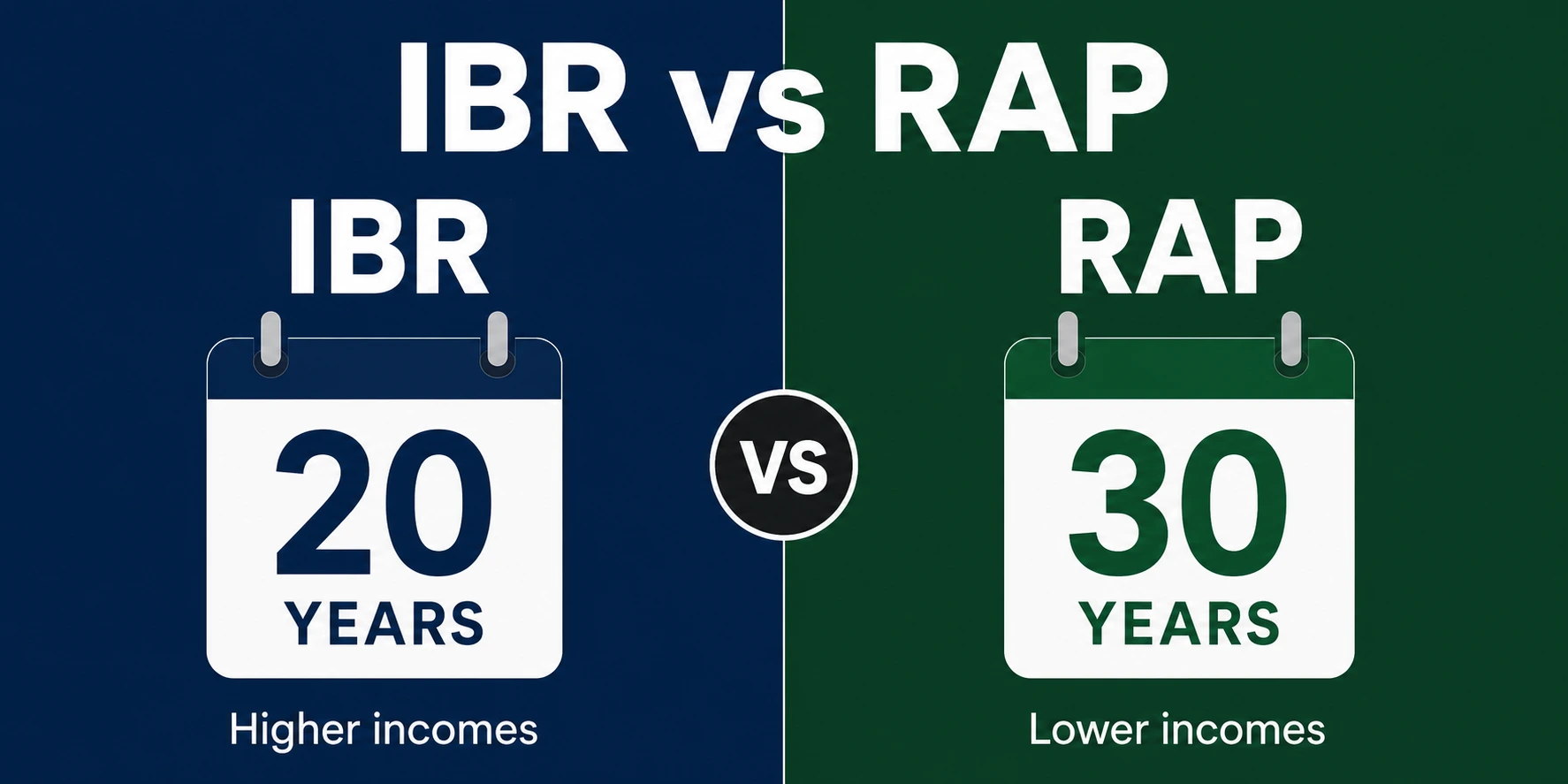
*Note: For borrowers with loans issued on or after July 1, 2026, IBR will no longer be available. Instead, the new RAP will replace it as the primary income-driven option. RAP offers PSLF eligibility, but its general forgiveness term is 30 years rather than IBR’s 20–25. See our guide on what the One Big Beautiful Bill means for student loans in 2025 for a full walkthrough of the new rules.
Final Thoughts
For years, the Standard Plan had a bad reputation. Borrowers were told to avoid it because the payments felt too high and it didn’t come with forgiveness. But that advice doesn’t fit everyone. For some borrowers, especially those with smaller balances and steady incomes, the Standard Plan can actually be the smarter, cheaper, and less stressful way out of debt.
The takeaway: don’t assume IBR is always the right move. Run the numbers, think about your career trajectory, and consider how long you want student loans in your life. The “best” plan is the one that gets you to financial freedom without unnecessary costs or wasted years.
Need help deciding between IBR, Standard, or another plan? Book a consultation with a CFP® Professional who specializes in student loans.
FAQs
No. IBR works best for borrowers with high debt compared to income, or those pursuing forgiveness programs. But if your income is strong and your balance is manageable, the Standard Plan often costs less overall.
Usually, you pay more interest on IBR. Lower monthly payments mean your balance sticks around longer, giving interest more time to add up. The Standard Plan pays loans off in 10 years, which cuts down on interest costs.
Yes, if your loans are eligible. You can request the change through your servicer or StudentAid.gov, though your payment will usually increase and unpaid interest may capitalize. Parent PLUS loans and new loans issued after July 1, 2026 face added restrictions, since some IDR options (like IBR) will no longer be available.
Your monthly payment will likely go up, but your loans will be gone faster and you’ll reduce the total interest you pay. Some borrowers use IBR early in their career, then switch to Standard once their income rises.
Technically, yes. Payments on the 10-Year Standard Plan do qualify for PSLF. The problem is that your balance would usually be paid in full by the time you hit 120 payments, which leaves nothing to forgive. That’s why most PSLF borrowers stick with income-driven repayment.
The Standard Plan does not qualify for long-term IDR forgiveness after 20 or 25 years. The only forgiveness path available under Standard is PSLF, and as noted, it rarely provides an actual benefit because the loan is fully repaid by the time PSLF would apply.
Not always. IBR helps if you have high debt compared to income or you’re aiming for forgiveness. But if your income is strong and your balance is small, the Standard Plan often costs less overall.
IBR bases payments on your income and can extend repayment to 20–25 years with possible forgiveness. The Standard Plan uses fixed payments over 10 years. Standard payments do qualify for PSLF, but since the loan is usually paid in full by then, there’s rarely a balance left to forgive.
Yes, for many borrowers with smaller balances and steady incomes. It costs more upfront each month but saves money on interest and gets you debt-free in 10 years.
About the Author

Pedro Gomez is the new Student Loan Sherpa and a Certified Financial Planner™ with over a decade of experience helping clients navigate complex financial decisions. He is the founder of Global Financial Plan, where he writes about international living, geoarbitrage, and strategies for retiring young, and also leads Brickell Financial Group, a registered investment advisory firm focused on accelerating financial freedom.
Pedro is the architect behind the “12 Levels of Financial Freedom” framework and blends student loan strategy with long-term planning, tax efficiency, and investing. His work is especially geared toward upwardly mobile professionals, entrepreneurs, and those looking to design a life beyond the default path.
Pedro is available for strategy sessions and press inquiries.


Hi, thanks for info., I was on IBR, moved to SAVE as soon as opened. Because I lost everything in Great Recession, my payment was zero but that counted. I know months on SAVE don’t count. But I currently stand at about 9.5 years into my 20. I am 69. Social security and IRA disbursement monthly, about 4600/monthly. When I called MOHELA twice after problems with SAVE popped up, I was told my social security wouldn’t count. I could not tell for sure but; if I switched to RAP, would my 9.5 years count? And then I’d only have .5 years left? How do you think they would calculate the monthly payment, I.e. would they take my $34k and divide by 6? I am thinking I will stay on SAVE until forced off. I figure at the stage, if I have to do the remaining 11.5 years, it’s a toss up whether I will die first or do the whole 11.5. Years. Plus of course, no one knows what future administrations will do. I figure if Dems, they may try to implement SAVE completely and if they all three branches, they could do it. They could also fight the current court case. But if SAVE repayment is going to kick in, I need to know; my 9.5 + .5 on RAP or 11.5 on BBB IBR. what do you think?
Hi Cindy,
Time spent in administrative forbearance under the SAVE Plan does not count toward forgiveness. However, prior time on IBR does count. Based on your estimate of 9.5 years, you have approximately 114 qualifying monthly payments.
The Repayment Assistance Plan (RAP), created under the One Big Beautiful Bill Act (OBBB), requires 360 qualifying monthly payments for forgiveness. Under the statute, payments made under IBR and other eligible plans do count toward RAP’s forgiveness timeline. Therefore, your prior 114 months from IBR would apply toward the 360 required under RAP.
Monthly payments under RAP are calculated based on Adjusted Gross Income (AGI). AGI typically includes taxable portions of Social Security and IRA disbursements. The monthly payment is based on a percentage of discretionary income, not by dividing annual income by a fixed number.
Thank you for the post Pedro. I think it’s important as well to pick the plan that best fits your financial needs. Personally, as much as I would like to go onto IBR from save and work on my PSLF forgiveness, I am extremely hesitant to do so when MOHELA can’t even figure my interest rate yet much less trust them to process my IBR application correctly. Sadly it seems to be a bit of hit and miss with them and getting it right.
Yes I am seeing borrowers having really bad experiences with Mohela. Nelnet seems to be the most responsive so far.