
Not all federal repayment plans count toward Public Service Loan Forgiveness. Choose the wrong one and years of payments won’t get you any closer to forgiveness — a mistake that has derailed thousands of borrowers who followed bad advice from their loan servicers.
This guide covers every PSLF-eligible repayment plan, the plans that don’t qualify, and what to do if you’ve already been on the wrong plan. It’s been updated to reflect the major repayment plan overhaul from the One Big Beautiful Bill Act (OBBB).
The Short Answer: Which Repayment Plans Qualify for PSLF?
The following plans count toward your 120 qualifying PSLF payments:
- Income-Based Repayment (IBR) ✅
- Pay As You Earn (PAYE) ✅ — closed to new enrollees July 1, 2026; sunsets entirely July 1, 2028
- Income-Contingent Repayment (ICR) ✅ — closed to new enrollees July 1, 2026; sunsets entirely July 1, 2028
- Repayment Assistance Plan (RAP) ✅ — new, available July 1, 2026
- 10-Year Standard Repayment Plan ✅ — qualifies but rarely the right strategy (see below)
The following plans do not count toward PSLF:
- SAVE Plan ❌ — permanently struck down March 10, 2026; not a viable PSLF path
- Graduated Repayment ❌
- Extended Repayment ❌
- Standard Repayment for consolidation loans ❌ — almost always ineligible, as the term is typically longer than 10 years based on balance; only qualifies if your term is exactly 10 years (rare)
- Tiered Standard Repayment Plan (new loans after July 1, 2026) ❌ — no tier qualifies for PSLF, regardless of term length; borrowers must enroll in RAP to earn PSLF credit
Why IDR Plans Are the Only Way to Actually Benefit From PSLF
Yes, the 10-Year Standard Repayment Plan technically qualifies for PSLF. But here’s the problem: if you make all 120 required payments on the standard plan, you’ll have paid off your entire loan balance by payment 120. There’s nothing left to forgive.
The entire financial benefit of PSLF comes from having a large remaining balance forgiven at the end. That only happens when your monthly payments are lower than what’s needed to fully pay off the loan in 10 years — which is exactly what income-driven repayment plans are designed to do.
The standard plan is only a useful PSLF strategy in one narrow situation: your income has increased significantly as you approach your 120th payment, and it becomes your only affordable PSLF-eligible option for those final months. In that case, switching to the standard plan for the last year or two is a reasonable bridge strategy.
Further Read:
If you’re weighing whether PSLF is even worth pursuing given your income trajectory, see our PSLF vs. refinancing guide.
For almost everyone else: if you want to benefit from PSLF, you need an income-driven repayment plan.
⚠️ The Consolidation Trap: If you’ve consolidated your loans, be careful — the “Standard” plan on a consolidation loan is almost never the same as the 10-Year Standard Plan. The repayment term for consolidation loans is based on your total balance and can stretch up to 30 years. Only a 10-year standard term qualifies for PSLF. The one exception: if your consolidated balance is under $7,500, the standard term is 10 years and would count. But since most PSLF borrowers carry balances well above that threshold, the practical advice remains the same — most borrowers who consolidate are automatically placed on a 20- or 30-year track without realizing it, and none of those payments count toward forgiveness.
⚠️ The Tiered Standard Repayment Plan (New Loans After July 1, 2026): The OBBB replaces the old Standard Plan with the new Tiered Standard Repayment Plan for loans taken out after July 1, 2026. Terms are tiered by balance up to 25 years. Critically, no tier of the Tiered Standard Repayment Plan qualifies for PSLF — including the 10-year tier. This is a hard break from the legacy 10-Year Standard Plan, which did qualify. Borrowers with new loans after July 1, 2026, must proactively enroll in RAP to earn any PSLF credit. Note also that IBR, PAYE, and SAVE are closed to any borrower — undergraduate or graduate — who receives a new loan disbursement on or after July 1, 2026.
The PSLF-Eligible Plans, Explained
Income-Based Repayment (IBR)
IBR is the most durable option for PSLF borrowers heading into 2026 and beyond. Unlike PAYE and ICR, IBR is not being eliminated under the OBBB — it will remain available after the July 1, 2028 deadline that phases out other plans.
IBR terms depend on when you first borrowed:
- Loans before July 1, 2014: 15% of discretionary income, forgiveness after 25 years
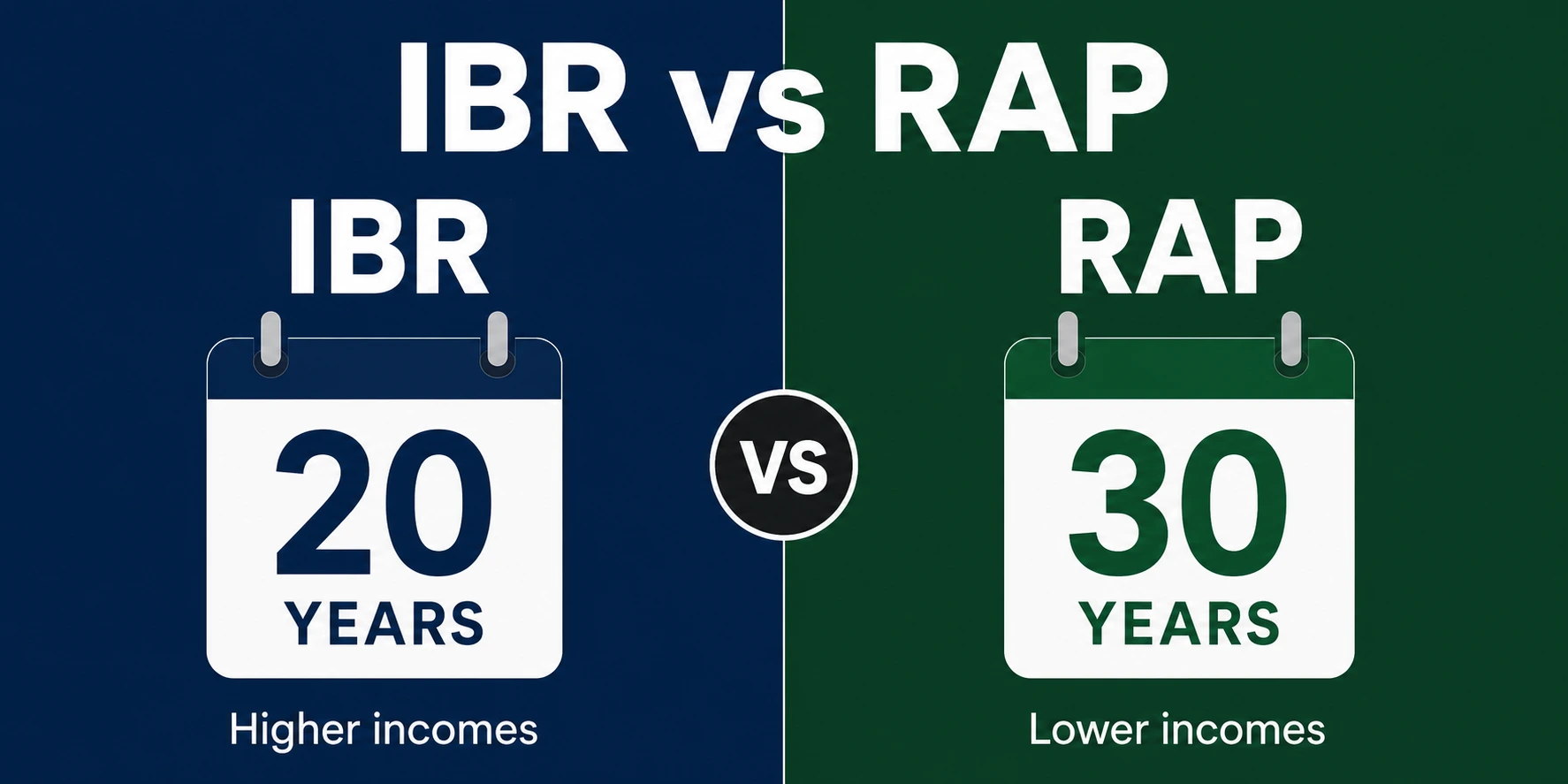
- Loans on or after July 1, 2014: 10% of discretionary income, forgiveness after 20 years
Important change as of July 4, 2025: The OBBB eliminated the partial financial hardship requirement to enroll in IBR. More borrowers can now qualify who previously couldn’t.
IBR payments are capped at the Standard Plan amount — so you’ll never pay more than you would on standard. However, there’s a nuance introduced by the OBBB: if you enroll in IBR without a partial financial hardship (which the OBBB now allows), your cap is set at the Permanent Standard Repayment Plan amount — effectively the 10-year standard payment calculated on the balance you owed when you enrolled — not necessarily the 10-Year Standard amount from when you first started repayment. For most borrowers this distinction is minor, but for high earners enrolling later in repayment it’s worth verifying the cap amount with your servicer.
Your IBR payment is calculated based on your income and family size. If you’re a high earner wondering how much income is too much for PSLF to make sense, see our guide for high-earning borrowers. If you’re married, how you file your taxes can significantly affect your IBR payment — our PSLF and marriage guide covers the married filing separately strategy in detail.
Important restriction for all new borrowers: IBR, PAYE, and SAVE are closed to any borrower — undergraduate or graduate — who receives a new loan disbursement on or after July 1, 2026. This applies to doctors, lawyers, and graduate students too. Taking out any new loan after that date restricts your entire loan portfolio to the Tiered Standard Repayment Plan or RAP — and because federal rules require all active loans to be on the same plan, borrowing after July 1, 2026 could force legacy loans off IBR as well.
Sherpa Take: If you’re borrowing any new federal loan after July 1, 2026 — for undergrad or grad school — RAP is your only IDR path. If you have existing loans on IBR and are considering going back to school, think carefully before borrowing new loans after July 2026. Doing so could force your entire portfolio off IBR and onto the new plans.
Pay As You Earn (PAYE)
PAYE charges 10% of discretionary income and is available to borrowers who had no outstanding balance when they borrowed their first loan after October 1, 2007, and received a disbursement after October 1, 2011.
Note: PAYE is closed to new enrollees as of July 1, 2026. If you are not already enrolled in PAYE, you cannot join it.
PAYE qualifies for PSLF — but it has a hard expiration date. PAYE will be eliminated by July 1, 2028. Borrowers still on PAYE at that date will be automatically moved to IBR or RAP.
If you’re currently on PAYE and pursuing PSLF, your payments count. Just make sure you actively select IBR or RAP before the 2028 deadline rather than being auto-enrolled in whatever your servicer chooses.
Income-Contingent Repayment (ICR)
ICR charges the lesser of 20% of discretionary income or a 12-year fixed payment adjusted for income. It’s generally the most expensive IDR option — but for certain borrowers, the 12-year balance-based calculation produces a lower payment than the standard plan. This is worth checking if your income is relatively high compared to your balance.
ICR has an important role for Parent PLUS loan borrowers — it’s the only IDR plan that has historically been available to them (after consolidation). However, like PAYE, ICR will be eliminated by July 1, 2028.
Two separate situations apply to Parent PLUS borrowers — don’t confuse them:
✅ Good News: The Double-Consolidation Loophole Is Dead — But You No Longer Need It. The old “double consolidation” strategy that allowed Parent PLUS borrowers to shed the Parent PLUS designation and access IBR is effectively closed. However, the OBBBA rendered it obsolete by creating a legal, single-consolidation pathway to IBR. Legacy Parent PLUS borrowers can now reach IBR — with its critical payment cap — by following these four steps in strict order before the hard deadlines:
Sherpa Note: The Department of Education recommended applying for consolidation by April 1, 2026 to ensure the loan disbursement is complete before the June 30 deadline. That recommended window has now passed. If you haven’t consolidated yet, apply immediately — do not wait. Processing times can take 30–60 days and the disbursement must be complete, not just submitted, by June 30, 2026.
- Consolidate your Parent PLUS loans into a Direct Consolidation Loan before July 1, 2026. This is the critical deadline. Missing it forecloses IDR access entirely.
- Enroll in ICR. This can be done after consolidation, any time before July 1, 2028.
- Make at least one qualifying payment under ICR. This step is mandatory — you cannot skip directly to IBR.
- Proactively switch to IBR before July 1, 2028. This locks in permanent access to IBR’s payment cap before ICR sunsets.
Do not rely on your servicer to prompt you through these steps. Treat each deadline as self-managed. Missing the consolidation deadline by even one day permanently forecloses this pathway.
Parent PLUS borrower racing the consolidation deadline?
This four-step pathway is unforgiving and self-managed. If you want a second set of eyes before you file, book a consult — we’ll confirm your steps and timing so you don’t lose IBR access over a technicality.
https://studentloansherpa.com/book/Book a consult
⚠️ New Parent PLUS Loans After July 1, 2026 (OBBB). The OBBB makes two significant changes for Parent PLUS loans disbursed on or after July 1, 2026. First, IDR access is eliminated entirely — including RAP — leaving only the Tiered Standard Repayment Plan, which does not qualify for PSLF under any tier, making PSLF effectively inaccessible. Second, the OBBB caps Parent PLUS borrowing at $20,000 per year per student and $65,000 lifetime, which will substantially change how many parents plan and budget for college costs.
Repayment Assistance Plan (RAP) — New in 2026
RAP is the new income-driven plan created by the OBBB, launching no later than July 1, 2026. RAP qualifies for PSLF, and for borrowers who take out new federal loans on or after July 1, 2026, it will be the only IDR option available.
How RAP works:
- Payments range from 1% to 10% of adjusted gross income (AGI), with a $10 minimum
- Uses total AGI — not discretionary income — as the base
- Unpaid interest is fully waived; the government also contributes a conditional principal subsidy of up to $50/month — but only when your payment doesn’t reduce the principal by at least $50. The subsidy equals the lesser of $50 or the gap between your payment and the amount applied to principal. It is not a flat monthly bonus.
- Forgiveness after 30 years for non-PSLF borrowers (PSLF still at 10 years)
Important PSLF-specific note on RAP: Because RAP payments are calculated on AGI and tend to be higher than what SAVE borrowers were paying, some PSLF chasers will have a smaller remaining balance at forgiveness under RAP than they would have had under SAVE. The forgiveness is still real — it just may be for a smaller amount. For borrowers with large balances and modest incomes, this difference is significant.
New borrower trap to know: For any borrower taking out loans on or after July 1, 2026, the Tiered Standard Repayment Plan does not qualify for PSLF under any tier — including the 10-year tier. This is a hard break from the legacy 10-Year Standard Plan. Regardless of your balance, you must proactively enroll in RAP to earn PSLF credit. If you’re just starting out and planning ahead, see our guide on starting the clock on PSLF as a student or recent grad.
Plans That Do NOT Qualify for PSLF
Graduated Repayment Plan
No. Graduated repayment starts with low payments that increase every two years. Payments under this plan do not count toward PSLF — even if you’re working for a qualifying employer.
Extended Repayment Plan
No. Extended repayment stretches payments over up to 25 years. These payments are not PSLF-eligible.
SAVE Plan
SAVE was permanently struck down by a federal district court on March 10, 2026, ending the program for the approximately 7 million borrowers who had enrolled. Months in the administrative forbearance that preceded the ruling do not count toward PSLF, and SAVE is not a viable path to PSLF progress under any scenario. Borrowers frozen in SAVE forbearance should specifically look into the PSLF Buyback program, which allows lump-sum payments to recover credit for those months. One important catch: you can only request a buyback once you’ve reached 120 months of qualifying employment — you can’t reclaim those frozen months early. The buyback is settled at the very end of your 10-year journey, not along the way.
Standard Repayment on Consolidation Loans
Consolidation loans often receive a repayment term longer than 10 years depending on the total balance. This longer-term standard plan does not qualify for PSLF — it’s a common and costly mistake. Only the original 10-Year Standard Repayment Plan (fixed exactly to 10 years) qualifies.
What If I’ve Been on the Wrong Plan? How to Fix It
This is one of the most painful situations in the student loan world — and it’s extremely common. Servicers gave bad guidance for years, steering borrowers onto graduated or extended plans while telling them they were on track for PSLF.
Not sure if your past payments count — or how to fix it?
Wrong-plan situations are personal: the fix depends on your loan types, your servicer’s records, and which deadlines still apply to you. Book a consult and we’ll review your actual payment history and map the fastest way to recover PSLF credit.
Book a PSLF consult
Here are your options:
Option 1: Switch Plans Now and Keep Going
The simplest fix: switch to a PSLF-eligible plan immediately. Payments you’ve made on an ineligible plan in the past won’t count, but every qualifying payment you make going forward will. You don’t lose anything by switching — you just can’t recover prior ineligible payments through a plan switch alone.
Before you assume those years are lost: If you were on the wrong plan before 2024, you may have already received credit toward PSLF through the one-time IDR Account Adjustment. Check your studentaid.gov dashboard to see if your payment count was updated automatically — many borrowers were surprised to find years of previously ineligible payments retroactively credited.
Option 2: Apply for TEPSLF
Temporary Expanded Public Service Loan Forgiveness (TEPSLF) was created by Congress specifically for borrowers who were on the wrong repayment plan. Under TEPSLF, some payments made on otherwise ineligible plans — graduated, extended, consolidation standard, consolidation graduated — can retroactively count toward your 120, provided you meet specific income thresholds. TEPSLF is applied for at the same time as PSLF forgiveness, not in advance, and is submitted through studentaid.gov.
Fine print: To qualify, the amount you paid in the 12th month before applying — and your final payment — must both be at least as much as you would have paid under an IDR plan. [See our full TEPSLF vs. PSLF guide for complete eligibility rules and how to apply.]
Option 3: Request PSLF Reconsideration
If you’ve already been denied, a denial is not necessarily final. You can submit a formal reconsideration request at studentaid.gov.
Our guide to PSLF application denials walks through the reconsideration process step by step. If you’re also exploring whether retroactive credit could apply to your situation, see our article on retroactive loan forgiveness and fixing PSLF errors.
What TEPSLF Cannot Fix
TEPSLF only addresses repayment plan issues. If your problem is ineligible loan types, TEPSLF won’t help — consolidation is typically the path forward for federal loan type issues. Note that if you have private student loans, those are never eligible for PSLF regardless of repayment plan — see private student loans and PSLF. If your problem is an ineligible employer, TEPSLF offers no relief — use the employer lookup tool to verify your employment qualifies before assuming a denial was a plan error.
⚠️ The IDR Tax Bomb: What Borrowers Pursuing Long-Term Forgiveness Must Know
This section matters most to borrowers on IBR or RAP who are not pursuing PSLF — those working toward 20- or 25-year IDR forgiveness instead. If you’re on track for PSLF, your forgiveness remains permanently tax-free, as it always has been. The same applies to TEPSLF.
The tax bomb affects IDR-based forgiveness only. The American Rescue Plan Act of 2021 temporarily made all student loan forgiveness tax-free through December 31, 2025. That exemption expired, and the OBBB did not extend it. Any IDR forgiveness received on January 1, 2026 or later is now treated as taxable income at the federal level — meaning a borrower with $80,000 forgiven after 25 years of IBR payments could face a significant IRS bill in the year of discharge.
A few important nuances:
- PSLF and TEPSLF are not affected. These programs have their own permanent statutory tax exemption that was never tied to the ARPA provision.
- State taxes may apply regardless. Even during the federal exemption period, some states taxed forgiven loans. Check your state’s conformity rules.
- The insolvency exclusion may help. If your total debts exceed your total assets at the time of forgiveness, you may qualify to exclude some or all of the forgiven amount from income under IRS Form 982. Consult a tax professional well in advance of your expected forgiveness date.
If you’re on IBR or RAP with a large balance and decades to go, factor this tax liability into your long-term financial planning now — not the year your loans are discharged.
The 2026–2028 Transition: What Current Borrowers Must Do
The OBBB significantly restructured the repayment plan landscape. [For the full political and legislative context on what’s changed and why, see our Future of PSLF article.] Here’s what matters practically for your PSLF payments:
| Plan | Status | Deadline |
|---|---|---|
| SAVE | Permanently struck down March 10, 2026 — unusable | Leave now |
| PAYE | Eliminated July 1, 2028 (closed to new enrollees July 1, 2026) | Switch before 2028 |
| ICR | Eliminated July 1, 2028 (closed to new enrollees July 1, 2026) | Switch before 2028 |
| IBR | Surviving — no action required | None |
| RAP | New, available July 1, 2026 | Optional switch |
If you’re on PAYE or ICR and pursuing PSLF, your payments through July 2028 still count. You don’t need to switch immediately — but you should actively choose IBR or RAP before the deadline rather than being auto-enrolled. Your servicer’s default enrollment may not be the optimal choice for your PSLF trajectory.
⚠️ Critical exception for Parent PLUS borrowers on ICR: If your ICR enrollment covers consolidated Parent PLUS loans, you must switch to IBR only — not RAP. Parent PLUS loans are explicitly ineligible for RAP even after consolidation. If you wait for auto-enrollment or select RAP, you will be forced onto the non-qualifying Standard Plan, losing PSLF eligibility entirely. Follow the four-step ICR-to-IBR pathway outlined in the ICR section above and make the switch proactively before July 1, 2028.
If you take out any new federal loan after July 1, 2026 — including a new consolidation loan — you lose access to legacy IDR plans for all your loans and are placed on RAP only. This is a critical trap for anyone considering consolidating existing loans after that date. Conversely, if you want to consolidate and preserve IBR access for the combined loans, you must do so before July 1, 2026 — that is the only window to keep legacy plan eligibility after consolidation.
Can You Switch Plans Without Losing PSLF Progress?
Yes. You can switch between any PSLF-eligible repayment plans without losing your payment count. Your certified qualifying payments carry over regardless of which eligible plan you were on when you made them.
A few things to watch during a switch:
- Interest capitalization: Rules vary critically depending on which plan you’re leaving. Switching from PAYE or ICR to IBR or RAP should not trigger capitalization — the 2023 IDR regulations eliminated those non-statutory capitalization events. However, leaving IBR is different: because IBR’s capitalization requirement is written directly into the Higher Education Act, exiting IBR (for example, to switch to RAP) will always trigger interest capitalization regardless of any regulatory changes. If you have significant unpaid interest on IBR, calculate the impact before switching.
- Administrative forbearance: Your servicer may place your account in a brief forbearance during the plan change. This month typically does not count as a qualifying payment — check your PSLF payment count after a plan switch to confirm your running total is accurate.
- Recertification timing: IDR plan switches reset your annual recertification date. Check with your servicer.
FAQs on PSLF Repayment Plan Eligibility
Yes. If your income qualifies you for a $0 monthly payment under an IDR plan, that $0 month counts as a qualifying payment as long as you’re working for a qualifying employer with eligible loan types. A $0 payment still requires active enrollment in an IDR plan — you don’t get automatic credit for months you simply didn’t pay.
Not necessarily. TEPSLF may allow some of those payments to count — see our TEPSLF guide for eligibility details. If TEPSLF doesn’t apply to your situation, then yes — prior ineligible payments cannot be recovered, and you’d work toward 120 qualifying payments from the point you switch to an eligible plan.
Only if the standard plan term is exactly 10 years. Consolidation loans often get longer standard terms based on balance — those do not count. Verify your plan term on your StudentAid.gov dashboard — as of 2026, the federal dashboard is the primary source of truth for plan terms and payment counts.
No — months in the SAVE administrative forbearance do not automatically count toward PSLF. Explore the PSLF Buyback program, which allows borrowers to make lump-sum payments to get credit for months that otherwise wouldn’t count.
It depends on when you first borrowed. For legacy borrowers already in repayment, PAYE or IBR generally produce the lowest payments. For all new borrowers after July 2026 — undergraduate or graduate — RAP is the only IDR option, and it scales from 1% to 10% of AGI, which can produce very low payments for borrowers with high debt-to-income ratios. Use the loan simulator at studentaid.gov to compare your specific numbers. High earners should also read our guide on how income level affects the PSLF calculus.
About the Author

Pedro Gomez is the new Student Loan Sherpa and a Certified Financial Planner™ with over a decade of experience helping clients navigate complex financial decisions. He is the founder of Global Financial Plan, where he writes about international living, geoarbitrage, and strategies for retiring young, and also leads Brickell Financial Group, a registered investment advisory firm focused on accelerating financial freedom.
Pedro is the architect behind the “12 Levels of Financial Freedom” framework and blends student loan strategy with long-term planning, tax efficiency, and investing. His work is especially geared toward upwardly mobile professionals, entrepreneurs, and those looking to design a life beyond the default path.
Pedro is available for strategy sessions and press inquiries.