
The SAVE repayment plan has ended.
Following a March 10, 2026, federal appeals court ruling that vacated the plan, the U.S. Department of Education has ceased all new SAVE enrollments and is transitioning the seven million affected borrowers into other plans. Interest has been accruing on these loans since August 1, 2025, and time spent in the recent administrative forbearance does not count toward Income-Driven Repayment (IDR) forgiveness or Public Service Loan Forgiveness (PSLF).
As a result, borrowers previously in SAVE must choose a new plan. This choice is critical; failing to act by your servicer’s deadline—typically 90 days after July 1, 2026—will result in an automatic move to a Standard Repayment Plan, which may significantly increase your monthly costs.
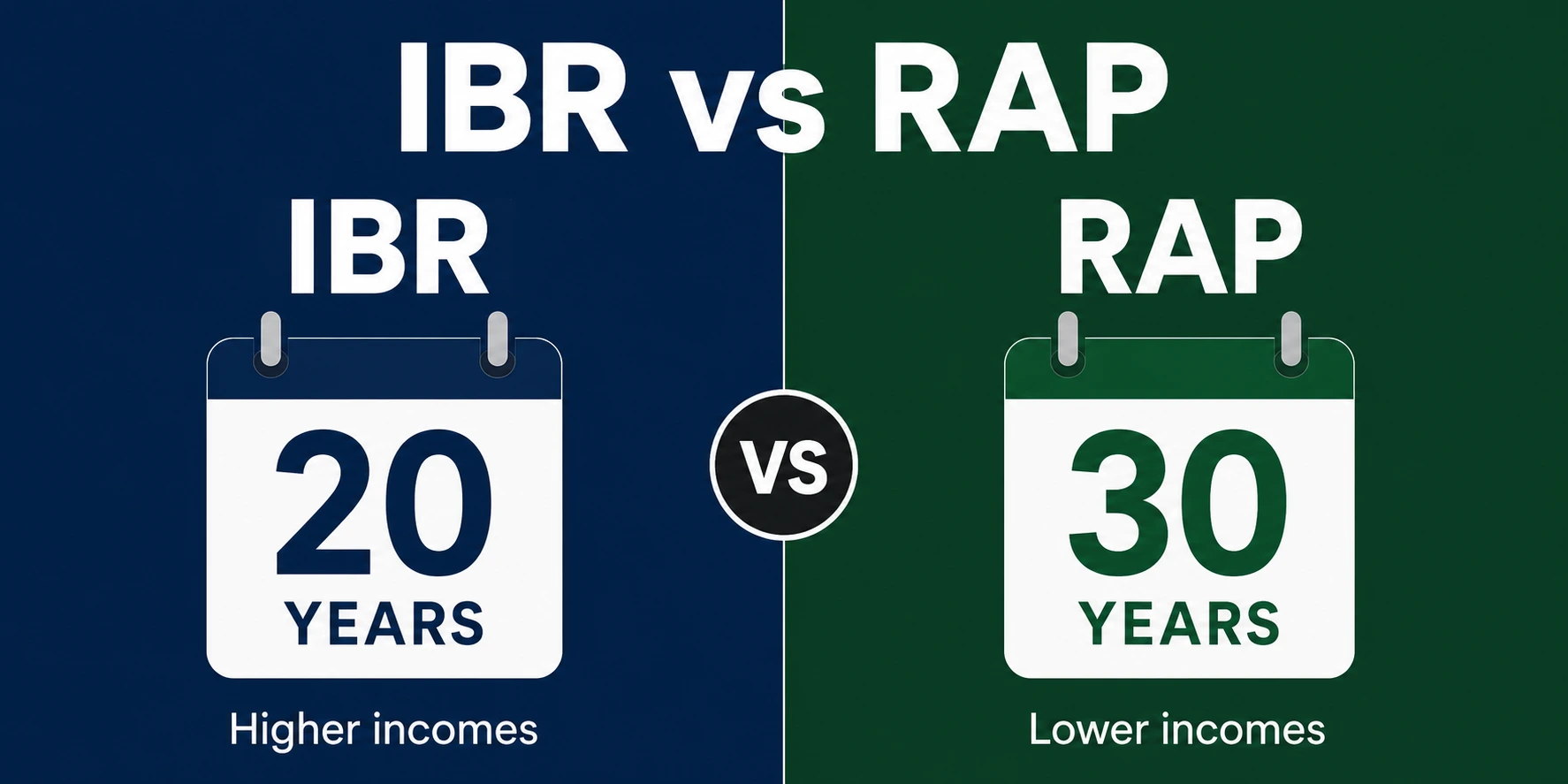
For most borrowers, the decision is now a three-way comparison between PAYE, IBR, and the new RAP plan (available July 1, 2026). While IBR remains the most ‘legally stable’ option, the new RAP plan offers a different tiered payment structure. Choosing the wrong plan can permanently affect your forgiveness timeline and determine whether unpaid interest is added to your principal balance.
PAYE vs IBR After SAVE: Which Plan Is Better?
For borrowers forced off the now-terminated SAVE plan, the choice between PAYE and IBR is primarily about flexibility versus commitment. Both plans cap payments and offer income-based forgiveness, but they differ in how easy it is to change plans later. PAYE generally offers more flexibility upfront, while IBR is easier to access but harder to exit once enrolled. PAYE is also a temporary option, scheduled to phase out entirely on July 1, 2028.
Most borrowers comparing PAYE and IBR are trying to answer one thing: which plan minimizes long-term cost while preserving flexibility.
| Feature | PAYE | IBR |
| Monthly payment | 10% of discretionary income | 10%–15%, depending on when you first borrowed federal student loans |
| Payment cap | Yes, capped at the 10-year Standard payment | Yes, capped at the 10-year Standard payment |
| Forgiveness timeline | 20 years | 20 or 25 years |
| Enrollment rules (2025) | Must meet PAYE eligibility rules | Broadly available, including borrowers without a PFH |
| Interest capitalization when switching | Does not capitalize interest when entering | Capitalizes unpaid interest when leaving |
Parent PLUS loans, Perkins loans, and defaulted loans generally require consolidation or rehabilitation before enrolling in IBR.
Bottom line: If you qualify for PAYE, it is often the safer first move after SAVE because it keeps more options open. New enrollments in PAYE will not be accepted on or after July 1, 2027, so borrowers leaving SAVE in late 2025 or 2026 should be aware that this window is closing. IBR may still be the right choice for borrowers who don’t qualify for PAYE, but it’s best suited for those prepared to stay in the plan.
Important note for borrowers with loans before July 1, 2014:
Under the original IBR rules, monthly payments are calculated at 15% of discretionary income, compared to 10% under PAYE. In addition, forgiveness under this version of IBR occurs after 25 years, compared to 20 years under PAYE.
These differences make PAYE meaningfully cheaper for eligible pre-2014 borrowers, though access is limited by PAYE’s technical requirements and upcoming phaseout.
Why IBR Is Hard to Leave Later
Interest capitalization occurs when unpaid interest is added to your loan balance. Once that happens, it becomes part of your principal and increases the amount of interest you pay going forward. It cannot be reversed.
This matters because interest has been accruing on SAVE loans since August 1, 2025, and IBR is one of the few income-driven plans where leaving the plan triggers capitalization.
Here’s the key rule borrowers need to understand:
- Leaving IBR for any other repayment plan causes all unpaid interest to capitalize at the time of the switch.
It doesn’t matter whether you move to PAYE, the Standard 10-year plan, RAP, or another option. Once you exit IBR, that interest is locked into your balance.
Because of this, IBR is difficult to use as a temporary stop. Even if a lower-cost or more flexible option becomes available later, switching out of IBR can permanently increase what you owe.
Rule of thumb:
If you qualify for PAYE, entering PAYE first usually preserves flexibility and limits permanent balance growth.
If PAYE isn’t available, IBR can still make sense, but it should be treated as a longer-term commitment, not a short-term bridge.
How PAYE and IBR Payment Caps Work
Even as borrowers move off SAVE, it’s still important to understand how payment caps under PAYE and IBR work and when they actually matter. These caps don’t determine which plan is best after SAVE, but they help explain why some borrowers previously worried about staying on uncapped plans long term.
PAYE and IBR offer a payment cap. If you earn so much money that your monthly payment is greater than what your payment would be on the 10-year standard repayment plan, your monthly bill is based on the 10-year plan. This offers protection for those in lucrative fields who fear that a SAVE payment could become unreasonably large.
One concern borrowers often raised with SAVE was that they could make many years of payments only to find that income-driven repayment no longer made sense once their income increased.
Not sure whether IBR or the Standard 10-year plan is right for you? Our IBR vs Standard Payment Plan guide breaks down the differences and helps you decide which plan fits your goals.
Eligibility and Access Limitations
Before SAVE was officially terminated in December 2025, enrollment rules limited which income-driven plans borrowers could access later, and those rules created confusion that still affects borrowers today.
Under changes enacted in the One Big Beautiful Bill Act (2025), the Department of Education temporarily reopened enrollment for PAYE, IBR, and ICR for eligible borrowers through July 1, 2026. As a result, borrowers forced off the terminated SAVE plan are not permanently barred from PAYE.
That said, access to PAYE is still conditional. Borrowers must meet PAYE’s original technical requirements, including the “new borrower” rule and the partial financial hardship test, to enroll or re-enroll.
By contrast, Income-Based Repayment (IBR) no longer requires a partial financial hardship to enroll. This makes IBR broadly available to borrowers leaving SAVE, regardless of income level.
The practical takeaway is that while PAYE access has been reopened on a temporary basis, it remains a narrower and time-limited option, whereas IBR functions as the more durable statutory fallback for borrowers who do not qualify for PAYE or miss the reopening window.
The Partial Financial Hardship Part of the Equation
A partial financial hardship (PFH) still matters for some income-driven plans, but it no longer applies uniformly the way it once did.
To enroll in PAYE, borrowers must demonstrate a partial financial hardship. In practical terms, this means your calculated income-driven payment must be lower than what you would pay under the 10-year Standard plan. If PAYE doesn’t reduce your payment, you can’t newly enroll.
For IBR, that restriction no longer applies. Under current law, borrowers leaving SAVE can enroll in IBR regardless of income level, even if their payment would exceed the 10-year Standard amount.
Once a borrower is enrolled in either PAYE or IBR, earning more money does not force them out of the plan. Instead, payments simply rise until they hit the 10-year Standard payment cap, where they remain unless income drops, the loan is paid off, or forgiveness is reached.
This distinction is most relevant earlier in repayment, when income trajectories are still uncertain. Borrowers without a partial financial hardship at the outset are less likely to benefit from income-driven forgiveness over the long term, particularly if higher income persists.
What Happens When PAYE Ends: Preparing for IBR or RAP
PAYE is not a permanent repayment plan. New enrollments will no longer be accepted on or after July 1, 2027, and the plan is scheduled to be fully phased out by July 1, 2028. Borrowers who are in PAYE at that point will be required to move into another repayment option.
For borrowers leaving SAVE now, this matters because choosing PAYE is best understood as a temporary bridge, not a long-term destination. PAYE can provide lower payments and preserve flexibility in the near term, but borrowers should expect another transition later, most likely into IBR or the new RAP once PAYE sunsets.
That future transition is expected to be administrative rather than elective. In other words, borrowers in PAYE won’t be left scrambling to choose a plan overnight, but they also won’t be able to stay in PAYE indefinitely.
The practical takeaway is simple:
PAYE can still make sense today as a first stop after SAVE, especially for borrowers who value flexibility and want to avoid locking in interest capitalization too early. Just don’t treat it as the final plan. Planning for one more move down the road is part of the strategy.
The Repayment Assistance Plan (RAP): What We Know So Far
The Repayment Assistance Plan (RAP) is a new income-driven repayment option created under recent legislation to eventually replace older IDR plans, including PAYE and ICR.
RAP is designed primarily for future borrowers and long-term transitions, not as an immediate replacement for SAVE. While details are still being finalized, RAP is intended to simplify the repayment system and standardize how income-based payments and forgiveness work going forward.
For borrowers leaving SAVE today, RAP is not an urgent decision point. Enrollment is not yet broadly available, and most borrowers will move into PAYE or IBR first before RAP becomes relevant to their situation.
At this stage, RAP is best viewed as a downstream option, not a plan borrowers need to actively choose or optimize for right now. Understanding that it exists is useful. Making repayment decisions based on RAP today is not.
When Paying Off Loans Faster May Make Sense
IDR exists to reduce total cost, not to win a forgiveness badge. In some cases, especially when income rises quickly or loan balances are modest, paying loans off faster can end up being the cheaper and simpler outcome.
This tends to show up when your required payment under an income-driven plan approaches or exceeds the 10-year Standard amount early in repayment. At that point, forgiveness is usually too far away to matter, and stretching repayment out can increase total interest paid without delivering much flexibility in return.
That doesn’t mean PAYE or IBR were “mistakes.” It just means that repayment decisions should stay responsive to reality. If your income stabilizes at a high level and your remaining balance is manageable, eliminating the debt outright can sometimes reduce risk, interest, and long-term complexity.
How to Think Through the Numbers
Start with your loan balance and realistic income projections for the next 20–25 years. Run scenarios for upside outcomes—raises, stable housing, manageable expenses—and downside outcomes, like slower income growth or unexpected costs.
For each scenario, ask: does paying extra now save more in interest? Would staying on PAYE or IBR give better long-term flexibility and forgiveness? Or is it better to pay off the debt fully? Patterns usually emerge even if there’s no single “perfect” answer.
If you want a detailed breakdown that accounts for your loans, career path, and financial goals, schedule a consultation to see how these choices could impact your overall plan.
About the Author

Pedro Gomez is the new Student Loan Sherpa and a Certified Financial Planner™ with over a decade of experience helping clients navigate complex financial decisions. He is the founder of Global Financial Plan, where he writes about international living, geoarbitrage, and strategies for retiring young, and also leads Brickell Financial Group, a registered investment advisory firm focused on accelerating financial freedom.
Pedro is the architect behind the “12 Levels of Financial Freedom” framework and blends student loan strategy with long-term planning, tax efficiency, and investing. His work is especially geared toward upwardly mobile professionals, entrepreneurs, and those looking to design a life beyond the default path.
Pedro is available for strategy sessions and press inquiries.