
Income-Based Repayment (IBR) and IBR for new borrowers (2014) are two very different federal student loan repayment plans.
The two IBR plans have different monthly payments, forgiveness timelines, and eligibility requirements.
I’ll explain why these two plans exist and how borrowers can determine the best option for their personal circumstances.
IBR and IBR for New Borrowers (2014): Federal Student Loan Income-Driven Repayment Plans
Over the years, the federal government has made an effort to make student loan repayment more manageable. For borrowers, this is a huge positive.
However, the downside of the ongoing efforts to assist borrowers is that many income-driven repayment (IDR) plans have been created over the years. IDR isn’t a specific repayment plan. Instead, it describes a broad category of federal repayment plans.
To understand the differences between IBR and IBR for new borrowers, it might be helpful to see how they fit in the context of the other federal repayment plans.
The federal government created the IDR plans in this order:
- Income-Contingent Repayment (ICR) – This was the first Income-Driven Repayment plan.
- Income-Based Repayment (IBR) – IBR was created to give borrowers lower monthly payments than the ICR plan.
- Pay As You Earn (PAYE) – When PAYE was created, it again lowered monthly payments for borrowers.
- Revised Pay As You Earn (REPAYE) – The goal behind REPAYE was to help borrowers who were not eligible for the PAYE plan. REPAYE later became the foundation for the SAVE plan.
- IBR for New Borrowers (sometimes called “New IBR”) – An updated version of IBR for borrowers who took out their first loans on or after July 1, 2014. It features lower payment caps and faster forgiveness than old IBR.
- Saving on a Valuable Education (SAVE) –
Introduced in 2023 as a major overhaul of REPAYE, SAVE lowered payments even further for many borrowers. As of 2025, SAVE is in legal limbo and scheduled to sunset in 2028 under current law.
It’s worth noting that not all loans and not all borrowers qualify for the above repayment plans. There are small details separating each option that can make a big difference for borrowers. The idea behind sharing the timeline is to provide a broad perspective on how the plans fit together.
Old IBR vs. New IBR: How Monthly Payments Are Calculated
Arguably the most significant difference between the two repayment plans is the monthly bill.
IBR charges borrowers 15% of their monthly discretionary income. IBR for new borrowers only charges 10% of the monthly discretionary income. Of all the federal student loan repayment plans, IBR for New Borrowers offers the lowest monthly payment.
To see what your monthly payment would be on each plan, visit The Department of Education’s Loan Simulator. Borrowers can see what their monthly payments would be on all repayment plans and examine various forgiveness options.
To make things clearer, here’s a side-by-side comparison of Old IBR and IBR for New Borrowers, covering monthly payments, forgiveness timelines, and eligibility rules:

Income-Based Repayment and Student Loan Forgiveness
Both IBR plans qualify for student loan forgiveness.
There are two main types of forgiveness that borrowers should consider:
Public Service Loan Forgiveness (PSLF) – Borrowers working for PSLF eligible employers can have their student loans forgiven after ten years worth of payments on both IBR and IBR for New Borrowers.
Income-Driven Forgiveness – All borrowers on Income-Driven Repayment plans are eligible to have their debt forgiven after a certain number of years. On traditional IBR, borrowers must make payments for 25 years to earn forgiveness. Borrowers on IBR for New Borrowers can achieve forgiveness after just 20 years. This distinction is one of the key differences between the two plans.
Borrowers working towards either form of forgiveness should carefully review all requirements and discuss them with their loan servicers.
Borrower Eligibility Requirements
The key difference between the two varieties of IBR is the “New Borrower” designation.
All federal student loan borrowers are eligible for the original IBR plan.
New borrowers who took out their first student loan after July 1st, 2014 are eligible for IBR for New Borrowers.
Borrowers who had student loans from before July 1st, 2014, should investigate the Pay As You Earn plan and the Revised Pay As You Earn plan. Both PAYE and REPAYE also charge borrowers 10% of their discretionary income.
IBR and IBR for New Borrowers Similarities
The two versions of IBR are identical in many important facets.
- Spousal Income – Borrowers on either plan may file taxes separately so that their spouse’s income isn’t included in student loan payment calculations.
- Tax on Forgiveness – Borrowers who earn PLSF will not be taxed on the forgiven debt. Borrowers who qualify for forgiveness after 20 or 25 years will be taxed on the amount forgiven.
- Eligible Loans – Most federal student loans are eligible for both plans. However, certain federal student loans not eligible for either form of IBR. These notable exceptions are Parent PLUS loans, FFEL loans made to parents, and consolidation loans that paid off parent loans. Additionally, Perkins loans are not eligible, but they can become eligible for both repayment plans if they are consolidated.
Deciding between IBR and IBR for New Borrowers
IBR for New Borrowers is the better repayment plan of the two. It has lower monthly payments and forgiveness arrives sooner.
Unfortunately, the “New Borrower” requirement will prevent many federal borrowers from qualifying for the preferred version of IBR.
Even though IBR for New Borrowers is clearly the better option between the two plans, it isn’t necessarily the best IDR plan. Borrowers should also carefully consider both PAYE and REPAYE. For those with larger balances and smaller incomes, the REPAYE interest subsidy may make REPAYE better than either version of IBR.
IBR Is Changing Again—Here’s What You Need to Know
While the original IBR and IBR for New Borrowers have served borrowers for years, major changes are now locked in. On July 4, 2025, President Trump signed into law the GOP’s sweeping reform package—officially dubbed the One Big Beautiful Bill—that overhauls federal student loan repayment.
For the latest updates on how these changes are affecting borrowers right now, see our monthly student loan repayment news & updates.
Among the biggest changes? A revamped version of IBR under Section 493C of the Higher Education Act, along with the creation of a brand-new Repayment Assistance Plan (RAP). These updates are designed to phase out older income-driven plans, and will significantly reshape repayment options for both current and future borrowers. Here’s what that means for you—and what’s coming in July 2026 when the new rules kick in.
IBR Under the One Big Beautiful Bill Act: What’s Changing?
Borrowers currently enrolled in ICR or related forbearance arrangements will be required to switch to one of the updated repayment options by July 1, 2028. One of those options is the revised IBR plan under Section 493C.
If a borrower doesn’t make a selection by that deadline, they will be automatically enrolled into either the new Repayment Assistance Plan (RAP) or the updated IBR (493C)—depending on the types of loans they have.
Monthly Payments Under the New IBR (Section 493C)
Under the revised IBR plan authorized by Section 493C of the Higher Education Act, monthly payments are tied to income and family size and retains a cap tied to the standard 10-year repayment amount.
Payment Calculation
Your monthly payment is based on your AGI and the federal poverty line for your family size. Specifically, for new borrowers who obtained their first federal loan on or after July 1, 2014, the applicable amount is calculated as: 10% of (AGI − 150% of the federal poverty line), then divided by 12 to determine your monthly payment.
Important Cap: If your calculated monthly payment exceeds what you would have paid under a standard 10-year repayment plan at the time you entered IBR, then your maximum monthly payment is capped at that 10-year amount.
Further Reading: Want to see how IBR stacks up against the standard 10-year plan? Check out our IBR vs Standard Payment Plan guide for a clear comparison of monthly payments, forgiveness timelines, and pros/cons.
Eligible Loans
You may enroll in this revised IBR plan if you have federal student loans made, insured, or guaranteed under Part B or Part D of the Higher Education Act — with two major exclusions:
- Excepted PLUS Loans: Parent PLUS loans do not qualify.
- Excepted Consolidation Loans: Consolidation loans used to repay an excepted PLUS loan or another non-qualifying consolidation loan also don’t qualify.
However, a notable exception exists: A Direct Consolidation Loan that is being repaid under ICR or another IDR plan between the date of this subsection’s enactment and June 30, 2028 will not be considered an excepted consolidation loan. This allows more borrowers with previously ineligible loans to transition into the new IBR framework.
Forgiveness and Repayment Terms
The revised IBR under Section 493C retains its own standalone forgiveness timeline. For new borrowers who had no outstanding loan balance on July 1, 2014, and no new loans after July 1, 2025, loan balances are cancelled after 20 years of qualifying payments under this plan. For other borrowers under IBR (Section 493C), the remaining balance on their eligible loans shall be cancelled upon completion of 25 years of qualifying payments.
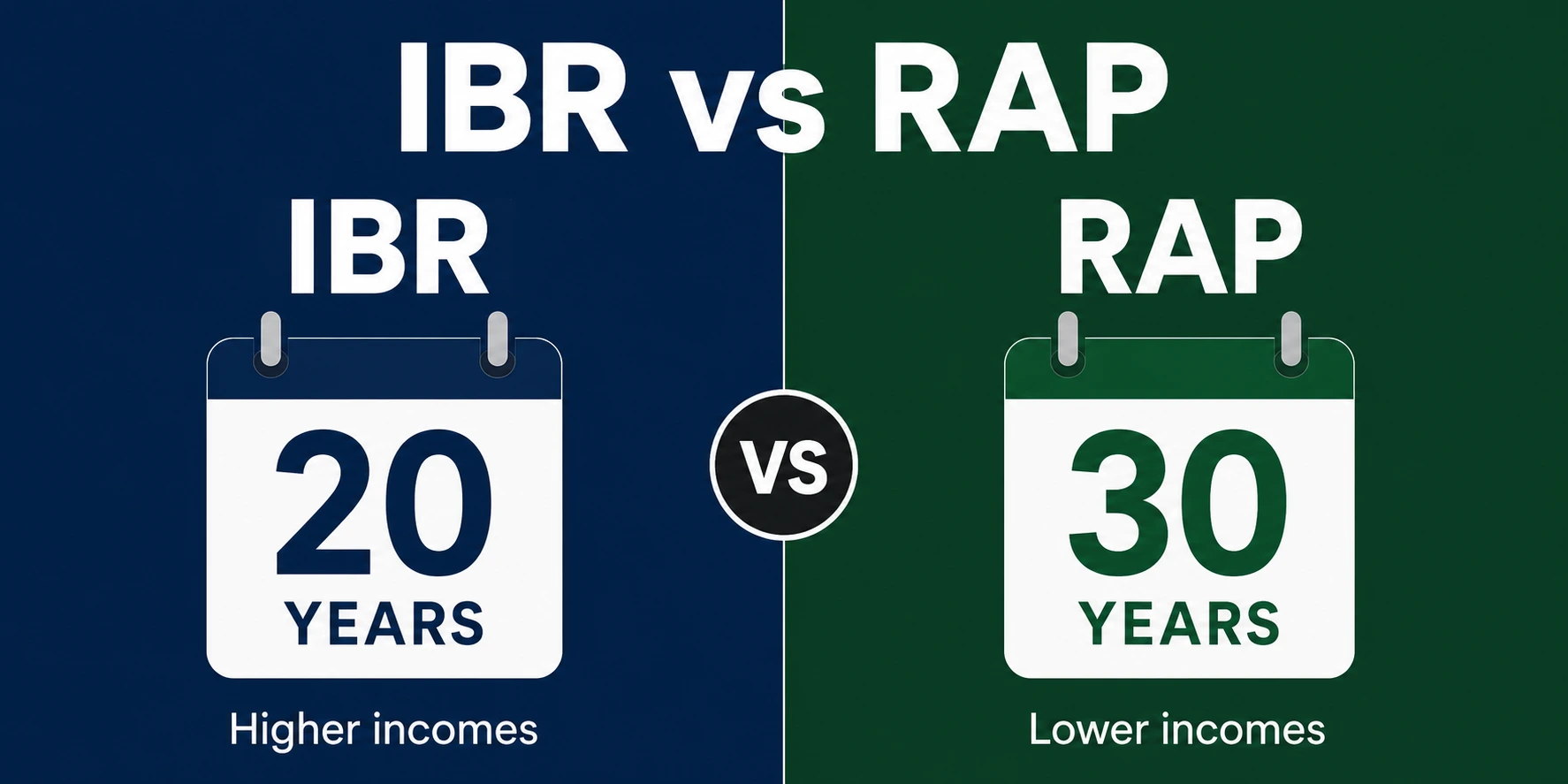
Payments made under the revised IBR directly count toward these specific forgiveness periods and are independent of the Repayment Assistance Plan (RAP), which offers forgiveness after 360 qualifying monthly payments (30 years).
Automatic Recertification: A Big Change
A major procedural improvement in the revised IBR is the implementation of automatic income recertification. The Department of Education will use IRS tax data to verify income annually, reducing paperwork.
Borrowers can opt out and submit income documentation manually if needed, but for many, this automation will streamline the annual renewal process. Read our guide on how to recertify your IDR plan if you’re doing it manually or want to understand the steps.
When Will These Changes Happen?
The revised IBR plan under Section 493C is already in effect for existing borrowers as of the date the bill was signed into law (July 4, 2025). This version replaces the previous “partial financial hardship” requirement with a new income-based formula and includes updated eligibility and recertification rules.
Starting July 1, 2026, all new federal student loans will no longer be eligible for existing income-driven repayment plans like SAVE, PAYE, or ICR. Instead, borrowers with new loans will have just two repayment options: the Repayment Assistance Plan (RAP) or the standard 10-year plan.
By 2028, existing borrowers still on older IDR plans will be transitioned to the revised 493C plan unless they opt into RAP or another qualifying plan beforehand.
The bottom line? IBR isn’t going away—but it is evolving. If you’re currently repaying loans under ICR or other older IDR plans, you’ll want to keep a close eye on these changes and consider your options well before 2028.
Want Updates Like This?
The rules are shifting fast — and we’re breaking them down as they happen.
Subscribe to The Sherpa Newsletter and get new posts, policy updates, and repayment tips sent straight to your inbox.
About the Author

Pedro Gomez is the new Student Loan Sherpa and a Certified Financial Planner™ with over a decade of experience helping clients navigate complex financial decisions. He is the founder of Global Financial Plan, where he writes about international living, geoarbitrage, and strategies for retiring young, and also leads Brickell Financial Group, a registered investment advisory firm focused on accelerating financial freedom.
Pedro is the architect behind the “12 Levels of Financial Freedom” framework and blends student loan strategy with long-term planning, tax efficiency, and investing. His work is especially geared toward upwardly mobile professionals, entrepreneurs, and those looking to design a life beyond the default path.
Pedro is available for strategy sessions and press inquiries.